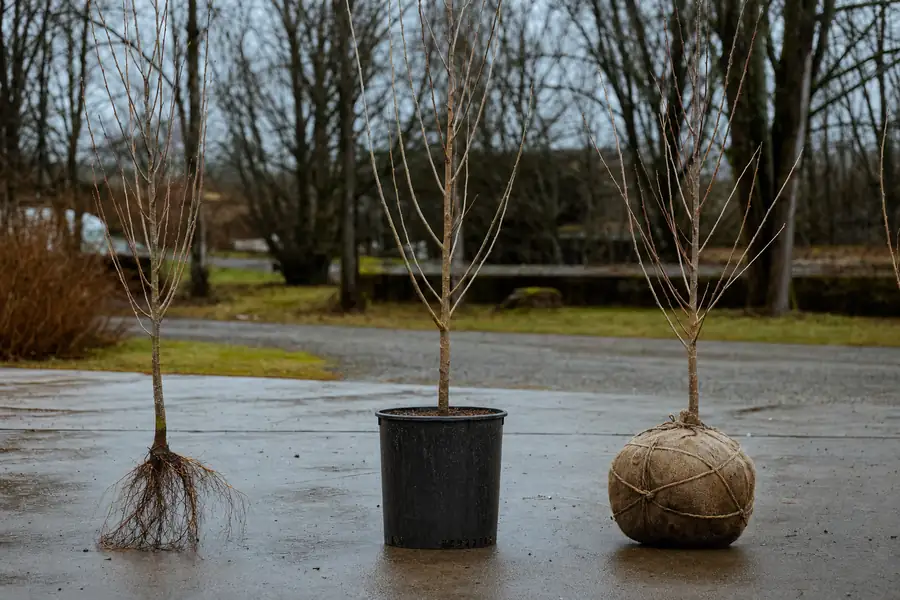
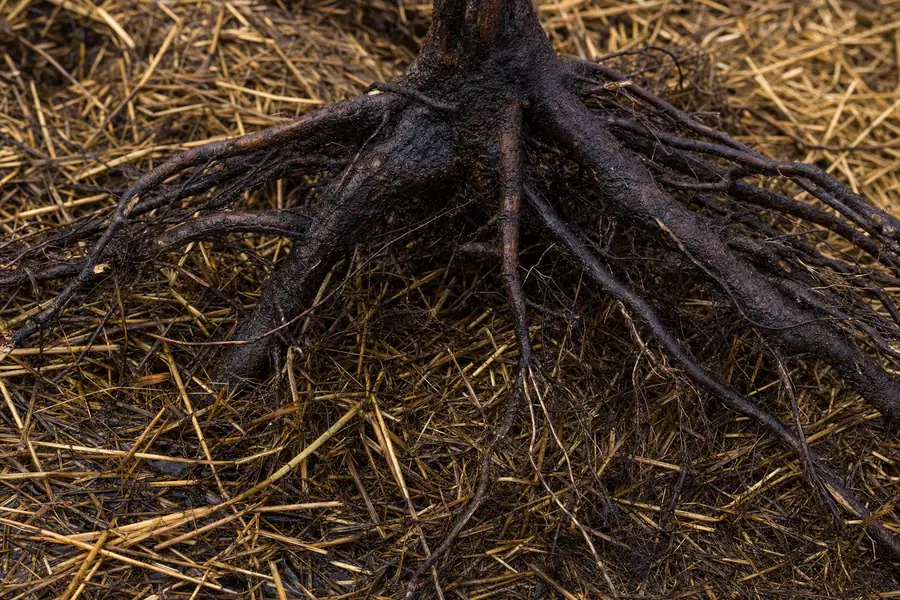
A bare root tree is lifted from the nursery field while dormant with no soil kept around its roots. That sounds like a disadvantage and often is not: you get far more root system per dollar, you can see every root before you plant it, and the roots go straight into your soil with no potting-mix boundary to cross. The catch is a narrow planting window - dormant season only - and zero tolerance for roots drying out. Get those two things right and bare root is an excellent way to buy a tree. Get them wrong and you have a dead stick.
Key takeaways
- Bare root means no soil, not no roots - often more root than a container tree of the same price.
- Dormant season only, roughly mid-November to mid-March, ground unfrozen.
- The roots must never dry out. This is the whole risk.
- You can inspect the entire root system before planting - a real advantage no other stock type offers.
- Sizes are limited. Bare root is generally small to medium stock.
- Arbor Buddy does not ship bare root. Our stock is established container and root-ball material.
What bare root actually is
Nursery trees are grown in one of three ways, and the difference is what comes with the roots.
| Stock type | What you receive | Planting window |
|---|---|---|
| Bare root | Roots and stem, no soil, usually in damp packing | Dormant season only |
| Container-grown | The tree in its pot, root system intact | Widest - whenever the ground is workable |
| Balled-and-burlapped (B&B) | Field-grown, dug with a soil ball wrapped in burlap | Dormant season preferred |
Bare-root trees are lifted in winter when they are fully dormant and not moving water. That dormancy is what makes the whole thing possible - a tree in leaf with naked roots would die in hours.
The real advantages
These are frequently understated, because bare root is usually sold on price alone.
| Advantage | Why it matters |
|---|---|
| You can see the entire root system | Circling roots, damaged roots, a buried root flare - all visible before planting. With container stock you find these out when you take the pot off, and with B&B you may never see them |
| More root per dollar | You are not paying to ship soil, so more of the price is tree |
| No soil interface | Roots go straight from your native soil into your native soil. Container stock arrives with potting mix, which dries at a different rate and creates a boundary roots hesitate to cross |
| No circling roots | There was never a pot wall to circle |
| Light and easy to handle | A bare-root tree one person carries would be a two-person root ball |
| Easy to position | You can spread roots deliberately rather than dropping in a ball |
The root-system point is the strongest one. Trunk-girdling roots are, per Colorado State Extension, "the most common cause of tree decline and death in the landscape" - and they typically originate from circling roots at planting. Bare root eliminates that failure mode entirely.
The real limitations
| Limitation | What it means in practice |
|---|---|
| Dormant-season only | A window of roughly four months, and in cold zones effectively a few weeks in early spring |
| Zero tolerance for drying | Roots must stay moist from lifting to planting. Not minutes exposed on a windy day |
| Smaller sizes | Bare root is generally small to medium stock; large specimens are not practical this way |
| Looks unconvincing on arrival | A dormant stick with roots. It is easy to assume it is dead |
| Usually needs staking | No root ball means no anchorage. ISA notes staking may be required for bare-root stock |
| Later to leaf out | Often noticeably behind container stock of the same species nearby |
| Limited species availability | Seasonal, and species-dependent |
Bare root versus container: an honest comparison
| Bare root | Container-grown | |
|---|---|---|
| Planting window | Dormant season only | Nearly year-round |
| Size available | Small to medium | Small to large |
| Root inspection | Complete | Only when you remove the pot |
| Circling roots | None | Common; must be cut at planting |
| Soil interface | None | Potting mix to native soil |
| Price for equivalent tree | Lower | Higher |
| Shipping | Light, parcel | Heavier; freight for large sizes |
| Handling risk | High - drying | Low |
| Immediate appearance | A dormant stick | A tree |
| Staking | Usually needed | Usually not |
| Establishment | Fast, when planted well | Fast |
Neither is better in general. Bare root is better value and structurally cleaner if you can plant it in the window and handle it correctly. Container is more forgiving, available year-round, and available in larger sizes.
When bare root is the right choice
- Planting a hedge, windbreak or orchard row - many trees, where cost per tree matters and small stock is fine
- You are planting in the dormant season anyway
- You want to see the roots before committing
- Access is difficult - no heavy root balls to move
- Reforestation or naturalizing, where quantity matters more than immediate size
When it is not
- You want immediate presence. Bare root is small and leafless when planted
- You are planting outside the dormant window
- You cannot plant promptly on arrival - holding bare root is possible but adds risk
- You want a large specimen tree
- Nobody will be available to water consistently through the first season
What Arbor Buddy ships instead
We do not sell bare-root trees. Our stock is established container and root-ball material - in our own words, well-rooted plants shipped at the right size, "not bare twigs."
That is a deliberate trade-off, and it is worth being clear about both halves of it:
What you gain: a much wider planting window, a tree that looks like a tree the day it arrives, sizes up to 14-16 ft on some species, and delivery timed to protect the tree in cold months.
What you give up: bare root's price advantage at small sizes, and the ability to inspect the entire root system before planting.
If what you want is a dormant-season hedge row at the lowest possible cost per plant, a bare-root supplier is the better fit, and we would rather say so. If you want a tree that arrives established and ready to plant across a much wider part of the year, that is what we ship - browse the range or find your zone first.
If you are buying bare root elsewhere, how to plant a bare root tree is the full method, and it applies regardless of where the tree came from.
Buying bare root well
If you are going ahead, these are the things that matter:
- Order for a delivery date inside your dormant window. Not before it, not after.
- Check the size specification. Bare root is typically sold by height or by caliper; the American Standard for Nursery Stock measures bare-root caliper "six inches above the root flare." See tree sizes explained.
- Ask how it will be packed. Damp packing material around the roots, sealed against drying, is the standard.
- Be ready to plant on arrival. This is the single biggest determinant of success.
- Inspect on arrival. Roots should be moist and flexible, not dry, brittle or blackened. Scratch the stem - green underneath means living tissue.
- Know the guarantee terms before ordering. Bare root carries more handling risk and policies vary.
FAQ
What are bare root trees?
Trees lifted from the nursery field during dormancy with no soil retained around their roots, usually shipped in damp packing material. They must be planted while still dormant.
Are bare root trees as good as potted trees?
They can be better in some respects - more root per dollar, no circling roots, no potting-mix boundary, and you can inspect the whole root system. The trade-offs are a narrow dormant-season planting window, no tolerance for roots drying out, and smaller available sizes.
When should you buy bare root trees?
So that they arrive within your dormant planting window - roughly mid-November to mid-March in much of the country, and early spring in cold zones. Order for a delivery date, not for stock sitting in a shed.
How long do bare root trees last before planting?
Plant them on arrival. If you cannot, keep the roots in damp packing somewhere cool and frost-free for a day or two, or heel them into a shallow trench outdoors for a week or more. Never let the roots dry out or warm up.
Do bare root trees need staking?
Usually yes. Without a root ball there is no anchorage while new roots establish. Stake low and loose, and remove within one year.
Why is my bare root tree not leafing out?
Bare-root stock commonly breaks bud noticeably later than container trees of the same species. Scratch a twig - green beneath the bark means living tissue. Wait until well past local bud break before concluding it has failed.
Does Arbor Buddy sell bare root trees?
No. We ship established container and root-ball trees, delivered ready to plant, which allows a much wider planting window and larger sizes than bare root permits.
We ship established, well-rooted trees rated for your climate, delivered ready to plant and covered by our 1-Year Thrive Guarantee. Find your zone to see what thrives where you live.