

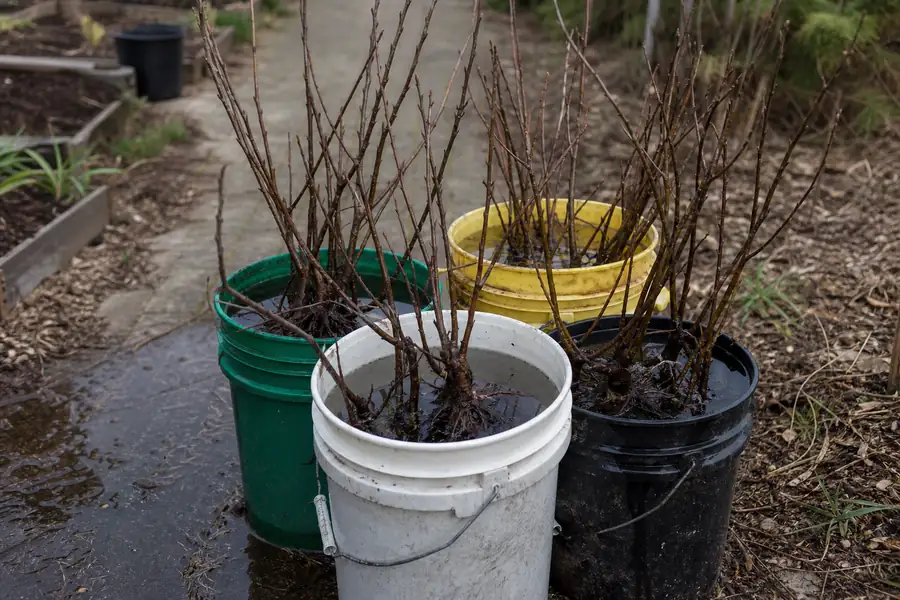
Bare root trees have no soil around their roots, so everything depends on two things: keeping the roots from drying out, and planting while the tree is fully dormant. Soak the roots for a few hours before planting, build a firm cone of soil in the bottom of the hole, spread the roots over it so the topmost roots sit just under the surface, and backfill with the soil you dug out. Done in the dormant season and watered properly afterwards, bare-root trees establish well - often faster than potted stock of the same size, because they have no circling roots and no mismatched soil interface.
Key takeaways
- Roots must never dry out. Not between the mailbox and the back garden.
- Plant dormant - roughly mid-November to mid-March in most of the country, whenever the ground is workable.
- Soak before planting, a few hours. Sources vary; do not exceed about 8 hours.
- Depth is still set by the root flare - here it is visible, which is one of bare root's advantages.
- Spread the roots over a cone, do not coil them into a narrow hole.
- Bare-root stock usually needs staking, unlike container stock, because there is no root ball anchoring it.
What bare root means, and why anyone uses it
A bare-root tree is lifted from the nursery field during dormancy with no soil retained on its roots. It is shipped as roots and stem, usually wrapped in damp packing material.
The advantages are real:
| Advantage | Why |
|---|---|
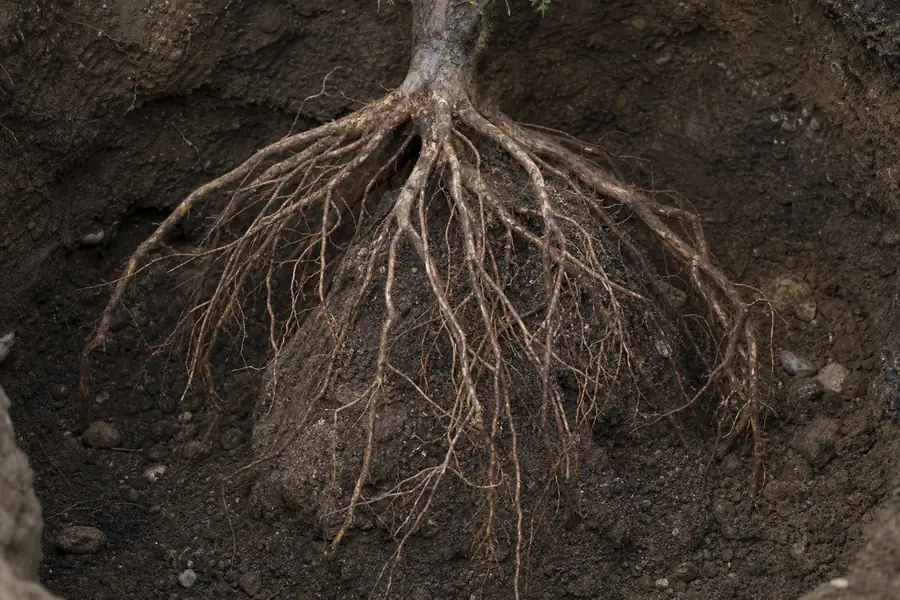
| You can see the entire root system | Defects - circling roots, broken roots, a buried flare - are visible before you plant, not twenty years later |
| No soil interface | The roots go straight into native soil, with no boundary between potting mix and ground soil for roots to hesitate at |
| Far more root per dollar | Nothing is being paid for or shipped except tree |
| Light to handle | A bare-root tree one person can carry would be a two-person root ball |
| Often establishes quickly | More fibrous root relative to size than a dug root ball of the same caliper |
The constraints are equally real: a very short planting window, zero tolerance for drying, limited availability, and almost always a smaller tree than you could buy potted.
What Arbor Buddy ships is not bare root. Our stock is established container and root-ball material - in our own words, "not bare twigs" - which is why our planting window is wider and our trees arrive at a usable size. If you want the method for what we ship, how to plant a container-grown tree is the relevant guide. This page is here because bare root is a legitimate way to plant a tree and the question deserves a proper answer.
Timing
Dormant season only, with the ground unfrozen - roughly mid-November to mid-March across most of the country.
The reason is not tradition. A dormant tree is not moving water, so roots with no soil around them can survive the handling. Once buds begin to swell, the tree starts transpiring, and bare roots cannot supply it.
| Region | Practical window |
|---|---|
| Zones 8-10 | December through February |
| Zones 6-7 | Late November through March |
| Zones 3-5 | March into April, as soon as the ground thaws - autumn is usually too late for roots to establish |
Plant as soon as the tree arrives. Bare root is not stock you store.
If you cannot plant immediately
| Delay | What to do |
|---|---|
| A day or two | Keep the roots in their damp packing, in a cool, dark, frost-free place - an unheated garage or shed. Check the packing is still damp |
| Up to a week or two | Heel it in. Dig a shallow trench outdoors, lay the tree at an angle with the roots in the trench, and cover the roots completely with soil or damp compost. Water it. The tree is effectively planted temporarily |
| Longer | Heel in properly, or pot it up into a container of damp compost, and plant out at the next opportunity |
Never leave bare roots exposed to sun or wind, store the tree somewhere warm, or let the packing dry out. Roots can be damaged by desiccation in minutes on a dry, breezy day - the critical thing is that roots stay moist right up to the moment the tree goes into the ground.
Soaking
Soak the roots in water before planting to rehydrate them.
How long? Here the sources genuinely differ, and it is worth knowing rather than being given a false precision:
- Some Extension guidance says one to two hours
- Others say one to six hours, or four to six hours immediately before planting
- Some European growers advise 24 to 48 hours
- The common caution is not to exceed about 8 hours, because prolonged submersion deprives roots of oxygen
Practical recommendation: three to six hours is a safe, well-supported range. If you are delayed, take the tree out of the water and heel it in rather than leaving it soaking overnight and beyond.
Soak the roots only - there is no benefit to submerging the stem.
Planting, step by step
1. Inspect and prune the roots
Before anything else, look at what you have.
- Remove broken, crushed or obviously dead roots with a clean, sharp cut. A clean cut compartmentalizes; a torn end does not.
- Leave healthy roots alone. Do not trim roots to fit a hole you have already dug - dig a bigger hole.
- Note the root flare. On bare-root stock it is plainly visible, which makes depth easy to get right.
- Look for circling or kinked roots and straighten them. If a root cannot be straightened, cut it.
2. Dig the hole to fit the roots
Dig wide enough that the roots can spread out fully without bending, and deep enough that the root flare will sit at or slightly above the surrounding soil.
The usual 2-3× root ball guidance does not translate directly, because there is no ball. The governing rule here is: the hole is as wide as the widest root reaches, and no deeper than it needs to be.
3. Build a cone
Mound firm soil in the center of the hole to form a cone. This is the step unique to bare root, and skipping it is the most common mistake.
The cone does two things: it gives the roots something to drape naturally over and down, rather than being bunched, and it supports the tree at the right height on undisturbed, firm material so it does not settle.
Build it so that when the tree sits on top of it, the root flare is level with the surrounding grade.
4. Set the tree and spread the roots
Place the tree on the cone and spread the roots evenly down and outward, like fingers over a ball. No root should be curling round the inside of the hole.
Check the height now. Lay a straight board across the hole: the root flare should touch it or sit slightly above. Adjust the cone, not the tree.
5. Backfill
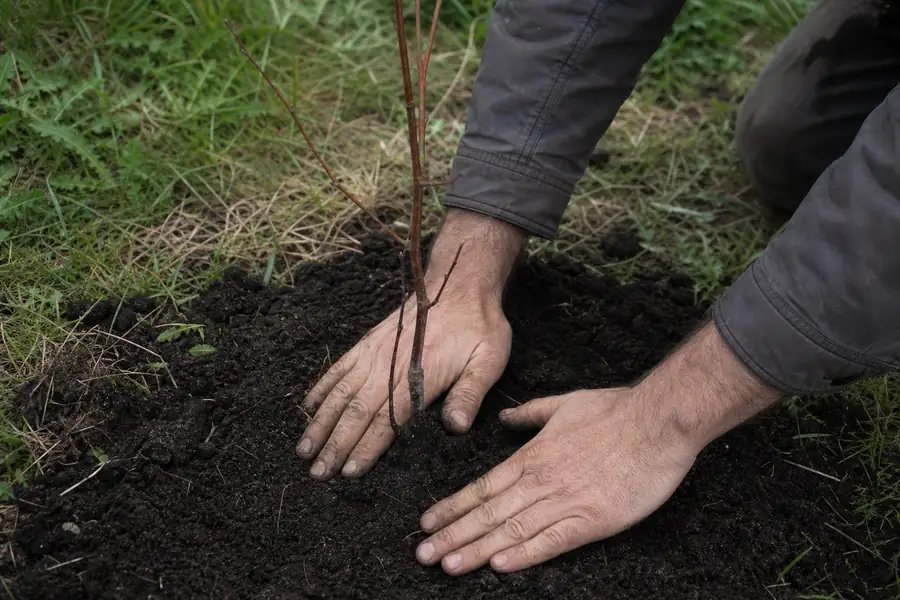
Backfill with the native soil you dug out - not compost, not potting mix, not fertilizer. Work soil in among the roots with your fingers as you go, so there are no voids around them. Firm gently in layers.
Half-fill, water to settle the soil into the roots, then complete the backfill.
Do not fertilize. ISA: "Avoid fertilizing at the time of planting."
6. Water thoroughly
Water deeply and slowly. The aim is to settle soil around every root and eliminate air pockets.
7. Stake it
Bare-root trees usually do need staking, which makes them the exception to the general rule. ISA notes staking may be required when planting bare-root stock - there is no root ball providing anchorage, so the tree has nothing holding it steady while roots grow.
Stake low, tie loosely with wide flexible material so the trunk can still flex, and remove within one year. See how to stake a tree.
8. Mulch
2-3 inches of coarse organic mulch over as wide an area as practical, kept clear of the trunk so the flare stays visible. See how to mulch around a tree.
Aftercare
A bare-root tree has lost a large share of its root system and has no reservoir of soil around what remains. The first season matters enormously.
| Period | What to do |
|---|---|
| First 2 weeks after bud break | Water every 2-3 days - 2-3 gallons per inch of trunk diameter |
| Through the first growing season | 2-3 times per week in warm weather, weekly otherwise. Check soil before each watering |
| First winter | Mulch well. In cold zones, consider a trunk guard against rodents and sun scald |
| Year 2 | Weekly through dry spells |
| Pruning | Dead or damaged wood only in year one |
| Fertilizer | None in year one |
Do not panic if it leafs out late. Bare-root trees commonly break bud two to three weeks after container stock of the same species nearby. Use the scratch test from transplant shock before concluding anything.
Common mistakes
| Mistake | Consequence | Fix |
|---|---|---|
| Letting roots dry out at any point | The most common cause of bare-root failure | Keep them wrapped and damp; plant straight from the soak |
| Planting into a hole that is too narrow | Roots bunched or coiled; the tree never anchors properly | Dig to fit the roots |
| Skipping the cone | Roots bunched downward, tree settles too deep | Build the cone |
| Trimming healthy roots to fit | Removes the root system you paid for | Enlarge the hole |
| Planting too deep | Same cascade as any tree - see how deep to plant a tree | Flare at or just above grade |
| Adding compost or fertilizer to the backfill | Creates an underground pot; nitrogen the tree cannot use | Native soil only |
| Not staking | Tree rocks, new roots are repeatedly torn | Stake low and loose; remove within a year |
| Planting after bud break | The tree transpires faster than bare roots can supply | Only plant dormant stock |
FAQ
When should bare root trees be planted?
While fully dormant and the ground is workable - roughly mid-November to mid-March in most of the country. In cold zones, early spring as soon as the ground thaws is generally better than autumn.
How long should I soak bare root trees?
Three to six hours is a safe, well-supported range. Guidance varies from one to six hours, and the common caution is not to exceed about 8 hours, because extended submersion starves roots of oxygen.
How deep do you plant a bare root tree?
So that the root flare - clearly visible on bare-root stock - sits level with the surrounding soil or slightly above it. Build a cone of firm soil in the hole and adjust its height until the flare lines up.
Do bare root trees need staking?
Usually yes, which makes them an exception. Without a root ball there is nothing anchoring the tree while roots establish. Stake low and loose, and remove within one year.
Why is my bare root tree not leafing out?
Bare-root stock often breaks bud two to three weeks later than container-grown trees of the same species. Scratch a twig: green underneath means living tissue. Give it until well after local bud break before concluding it has failed.
Are bare root trees better than potted trees?
They are different trade-offs. Bare root gives more root per dollar, no circling roots, no soil interface, and a visible root system - but demands dormant-season planting and perfect handling. Container stock can be planted in a much wider window and arrives larger, but can carry circling roots and a potting-mix interface.
Can I plant a bare root tree in summer?
No. Bare-root stock must be planted while dormant.
Arbor Buddy ships established container and root-ball trees rather than bare-root stock, which means a wider planting window and a larger tree on arrival. Find your growing zone to see what thrives where you live - everything is backed by our 1-Year Thrive Guarantee.