

Quick answer: Most new trees don't need staking. Learning how to stake a tree correctly starts with knowing when to skip it entirely: bare-root stock, loose or small root balls, windy sites, and top-heavy evergreens are the real exceptions. When staking is needed, use two stakes, wide soft straps, leave a couple inches of sway, and remove everything within one growing season, one year at the outside.
It would be easy to sell a staking kit with every tree we ship. The honest answer for most yards is that you don't need one, and that's the advice we give even though it costs us a sale. A nursery-grown tree with a solid root ball is built to stand on its own from the day it goes in the ground.
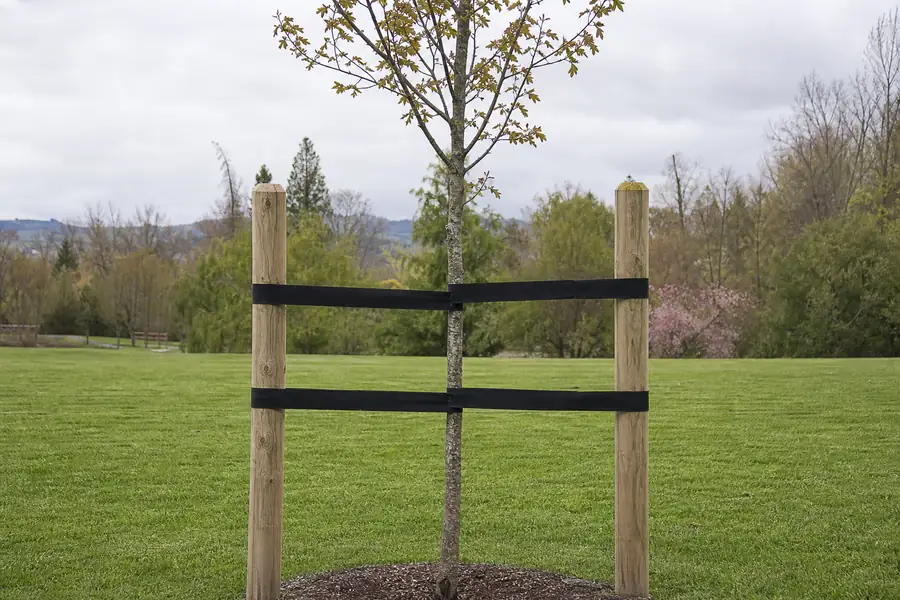
When to Skip the Stake
A container-grown tree with a solid, well-rooted ball stands upright on its own and doesn't need a stake. Trunk taper, the natural widening of a trunk from top to base, comes from the trunk flexing in the wind. That flexing is what makes a trunk strong enough to hold up a full canopy for decades.
Rigid staking stops that movement. University extension research on nursery stock has shown the same result again and again: unstaked trees develop thicker, better-tapered trunks than staked ones planted the same day. A trunk that never has to work for itself grows thin, and it can buckle the moment the support comes off.
If your new tree's root ball is solid and the planting site isn't especially exposed, leave the stakes at the nursery. Browsing our shade trees selection, you'll notice most nursery-grown stock ships with a root ball sized to stand on its own.
When Staking Earns Its Keep
Staking helps when the root ball, not the trunk, is the weak link. That covers bare-root trees over about 5 to 6 feet tall, trees with small or loosened root balls, top-heavy evergreen canopies that catch wind like a sail, and trees going into sloped or wide-open sites.
Wind exposure matters more than most people expect. A tree tucked between a house and a fence rides out storms that would rock the same tree standing alone in an open yard. Check your zone before planting so you know what your winters and wind patterns actually demand of a new tree, not just what species survives there.
Evergreens like evergreen trees carry a lot of canopy relative to their root ball right after planting, which makes them prone to leaning until roots catch up. If your site checks any of these boxes, staking for one season is the right call, not a mistake.
How to Stake a Tree Using the Two-Stake Method
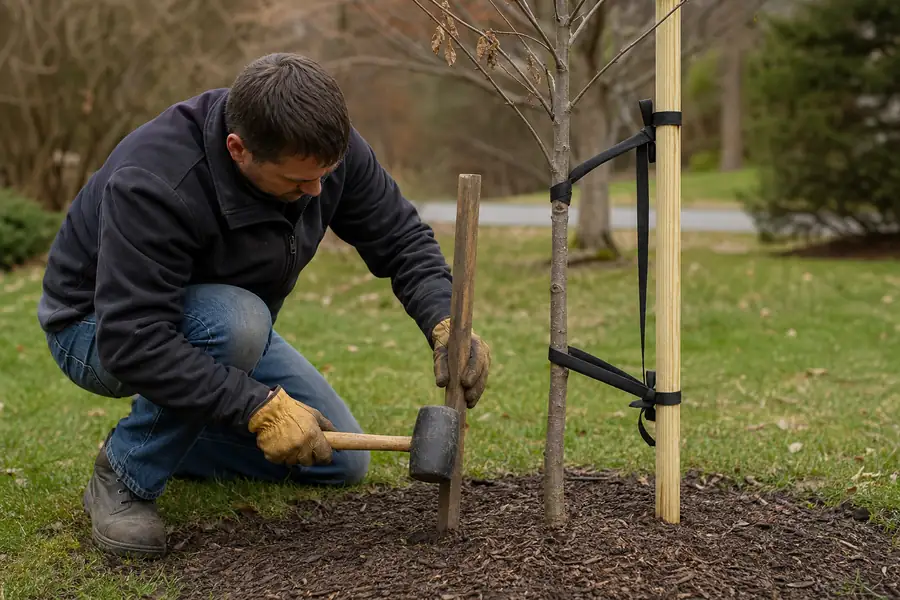
The two-stake method holds a trunk steady without locking it rigid, and it's the standard for most new trees that actually need support. Drive two stakes outside the root ball, never through it, lined up across the prevailing wind so the tree can still flex forward and back.
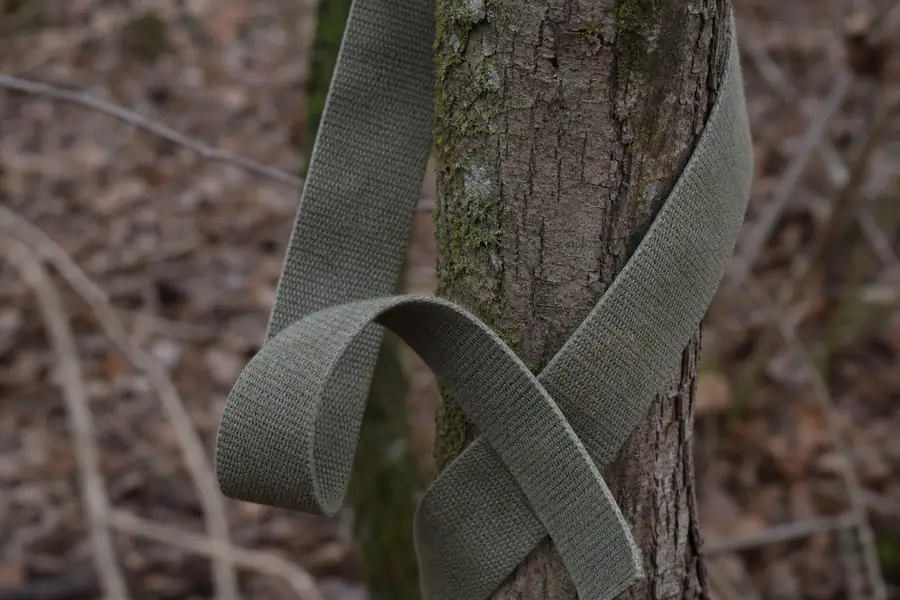
Attach wide, soft tree straps at about one-third to one-half of the trunk's height, as low as the position that still stops the root ball from rocking. Tie them loose enough to leave a couple of inches of sway in the trunk. That sway is doing real work: it's the same trunk-building movement described above, just controlled instead of unlimited.
Skip the old trick of running wire through a piece of garden hose. It looks gentle, but wire under tension still cuts into bark over a season, a slow form of girdling, where a tight material cuts through the bark and the layer beneath it until it strangles the trunk. Use a real strap, not wire and hose.
Guying Taller Trees
Guying is the right call for trees well over 10 feet tall, where two side stakes can't handle the leverage of a full canopy. Guying anchors the trunk with three lines run to ground anchors spaced evenly around the tree, instead of stakes driven right next to the trunk.
Keep the straps low on the trunk, following the same one-third to one-half height rule as the two-stake method, and run the lines out to anchors set well outside the root ball. Flag each line with bright tape or ribbon so nobody trips over a guy wire that's easy to miss at ankle height.
The Removal Deadline
Stakes and straps should come off after one growing season, one year at the absolute outside. Check the straps monthly and loosen them as the trunk thickens, because a strap that fits fine in spring can be too tight by fall.
Straps left on for two years or more start cutting into the bark. That's girdling in slow motion: the strap doesn't move, the trunk keeps growing, and eventually the material chokes off the flow of water and nutrients right at that band. A trunk with a strap scar carries that weak point for the rest of its life, even after the strap is long gone.
Still Floppy After a Year?
A tree that still can't stand on its own after a full growing season has a problem below ground, not above it. The usual suspects are a buried root flare (the point where trunk meets roots, which needs to sit at or just above soil level), roots that are still circling the shape of the old container instead of spreading outward, or a root ball that was undersized for the tree's height from the start.
Re-staking for another year just delays the diagnosis. Dig down to the flare, check for circling roots, and fix what you find instead of propping the tree up indefinitely. If you're still narrowing down species for a windy or sloped site, our Plant Finder quiz can point you toward trees suited to those conditions from the start, so staking becomes the exception rather than the rule.
FAQs
Does every new tree need a stake?
No, most new trees don't need a stake. A container-grown tree with a solid root ball usually stands upright on its own, and staking it anyway can weaken trunk taper over time.
How long should stakes stay on a tree?
Stakes and straps should come off after one growing season, one year at the outside. Leaving them longer risks the straps cutting into the bark as the trunk thickens.
How tight should tree straps be?
Tree straps should be loose enough to let the trunk sway a couple of inches in the wind. That movement is what builds a strong, well-tapered trunk over time.
Should I use wood or metal stakes?
Either wood or metal stakes work fine as long as they're sturdy and driven outside the root ball. What matters more is using a wide, soft strap where it meets the trunk, not wire or twine.
My tree leaned over after a storm. What do I do?
Straighten the trunk while the soil is still wet and workable, then stake it loosely for one season to let the roots re-establish. If it leans the same way again once the stake comes off, check the root ball and flare for a deeper problem.