

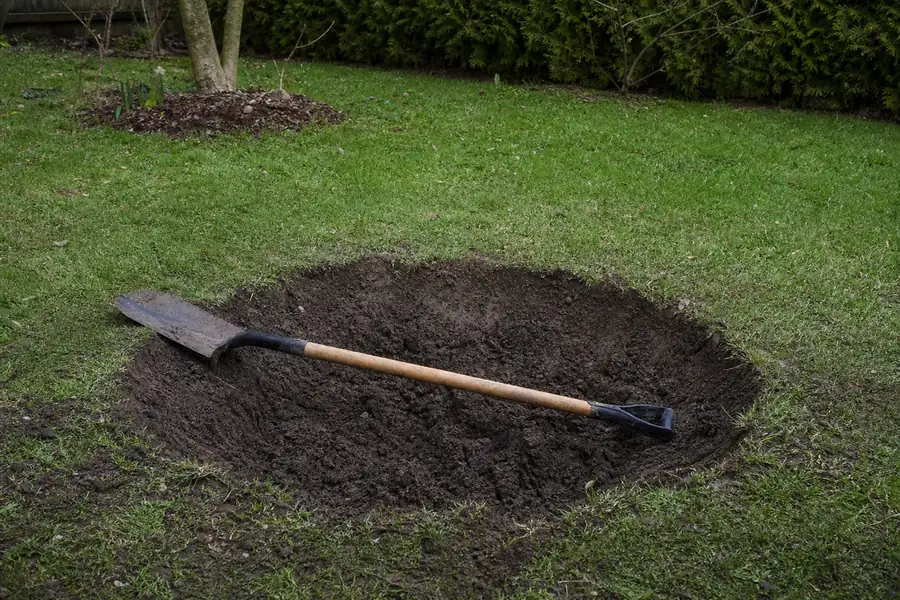
Plant so that the root flare - the point where the trunk widens into its topmost roots - sits level with the surrounding soil or slightly above it. The hole should be no deeper than the distance from that flare to the bottom of the root ball. Do not use the soil line in the pot or the top of the root ball as your reference, because nursery stock is frequently grown or balled with several inches of soil over the flare. On poorly drained sites, plant deliberately higher.
Key takeaways
- Depth is measured from the root flare, not the container surface. These are often not the same point.
- Too deep is far more dangerous than too shallow. A slightly high tree can be mulched. A buried tree suffocates slowly.
- The damage takes years to show. Colorado State calls stem-girdling roots the most common cause of landscape tree death, typically appearing "twelve to twenty plus years after planting."
- A tree planted too deep can be lifted and re-set - easily within the first season, with difficulty for a couple of years, and not at all after that.
- On wet sites, plant up to one-third of the root ball above grade.
The one measurement that matters
Almost every planting guide says "plant at the same depth it was growing in the nursery." That sentence is the source of the problem, because it assumes the nursery got it right.
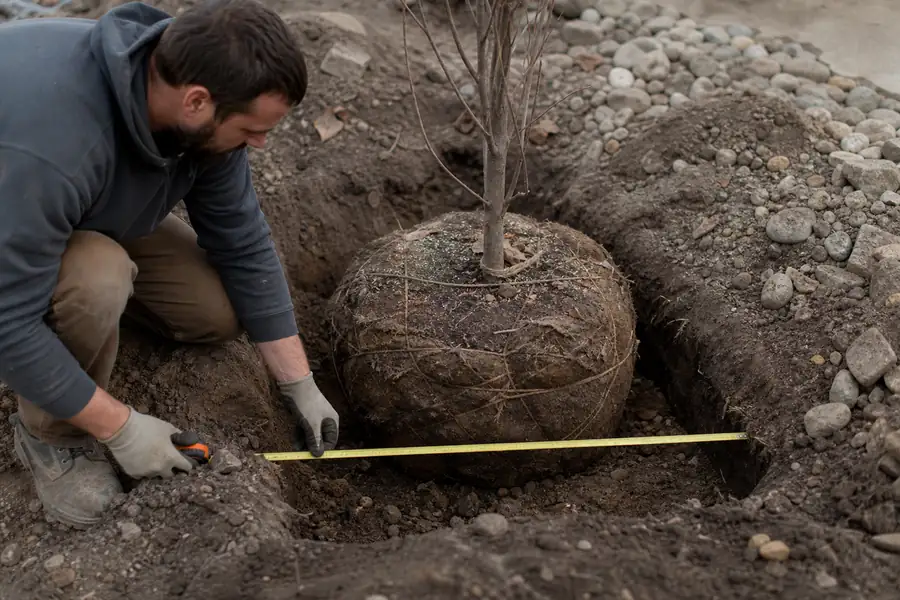
The correct reference is the root flare (also called the trunk flare or root collar): the point where the trunk stops being a straight cylinder and swells outward into the first structural roots.
UF/IFAS states it plainly: "Find the point where the uppermost root emerges from the trunk. This point is called the trunk flare, root flare or root crown and should be even with, or slightly above, the soil surface."
ISA adds the inspection step: "Ensure trunk flare is partially visible after the tree is planted. Remove excess soil prior to planting if flare is not visible."
Colorado State goes further on the target, specifying that at least two structural roots should be within the top one to three inches of soil, and for species prone to girdling - crabapples and green ash among them - the top structural root should be within the top inch.
Finding the flare takes about two minutes
- Set the tree where you can work around it, still in its pot or ball.
- Brush and scrape soil away from the trunk with your fingers, a hand cultivator or a gentle stream of water.
- Stop when you reach the first large root leaving the trunk. The trunk will visibly widen there.
- Measure how much soil was sitting above it. That number is the correction you must apply to your hole depth.
If you found three inches of soil above the flare, then the "top of the root ball" is three inches above where the top of the root ball should functionally be - and a hole dug to match the ball will plant the tree three inches too deep.
Deeper treatment in the tree root flare, explained.
How to set the depth, step by step
| Step | What to do | How you know it is right |
|---|---|---|
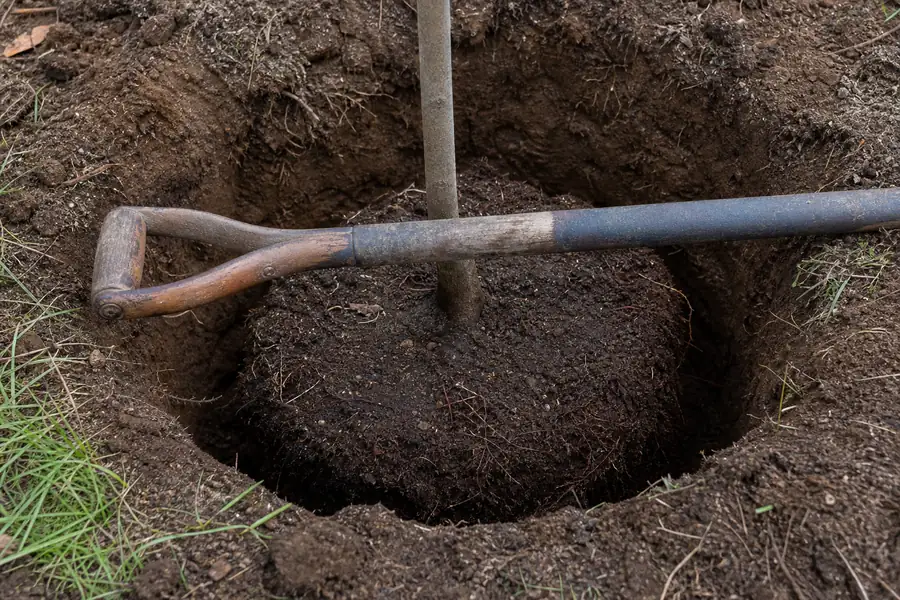
| 1 | Expose the flare and measure from the flare down to the base of the root ball | You have one number, in inches |
| 2 | Dig the hole to exactly that depth, 2-3× the ball's width | A tape in the hole reads the same number |
| 3 | Leave the base of the hole undisturbed. Do not loosen or backfill underneath | Your shovel has not touched the bottom |
| 4 | Set the tree in and lay a straight board across the hole | The flare touches the board or sits slightly proud of it |
| 5 | Adjust by removing soil from the top of the root ball, not by digging deeper | The flare rises; the ball still sits on firm ground |
Step 3 is the one people get wrong. Loose soil beneath a root ball compresses under the weight of the tree and the first few waterings. A tree set correctly on fluffed soil will be two inches too deep a month later. Undisturbed soil does not settle.
Why too deep is so much worse than too shallow
A tree planted too deep fails through four mechanisms at once, none of them fast enough to connect to the cause.
Oxygen. Roots respire. In good soil roughly half the absorbing roots sit in the top 12 inches, and in compacted or clay soil Colorado State puts 90-95% of the root system in the top 12 inches or less. Bury the root system below that layer and you have moved it out of the zone where oxygen exists.
Bark that should never be underground. The trunk's bark is not adapted to constant soil moisture. Buried, it stays wet, and it decays.
Girdling roots. Roots emerging from a buried flare have nowhere to go but around the trunk. Over a decade or two they thicken, meet the expanding trunk, and strangle it. This is the slow killer, and the one that makes planting depth worth taking seriously.
Water sitting where it should not. A deep hole in heavy soil becomes a sump.
The symptoms, and why they are so easy to misread
A tree planted too deep typically looks like a tree that needs more water - and watering it makes things worse.
| Symptom | Appears | Commonly blamed on |
|---|---|---|
| Thin, sparse canopy; small leaves | Years 2-5 | Needs fertilizer |
| Early fall color, premature leaf drop | Years 2-6 | Drought |
| Dieback starting at the branch tips | Years 3-10 | Pests or disease |
| Trunk enters the soil like a telephone pole, with no visible flare | Immediately | Nothing - nobody looks |
| Trunk flattened or indented on one side at the base | Years 10-20 | Mechanical damage |
| Sudden decline or failure of an apparently mature tree | Years 12-20+ | "It just died" |
The fourth row is the diagnostic one, and it takes five seconds. Walk up to the tree and look at the base. If the trunk goes into the ground like a post, with no widening, something is wrong. A healthy tree base looks like a foot in a shoe, not a pole in a hole.
I already planted it. Can I fix it?
Usually, and the window is wider than people assume. What matters is how long the tree has had to grow new roots into its (wrong) position.
| Time since planting | Recommended fix | Difficulty |
|---|---|---|
| Same day to a few weeks | Lift the tree, add firm soil beneath the ball, re-set with the flare at or above grade | Easy. Just do it |
| First growing season | Same lift-and-reset. Best done in cool weather, and water carefully afterwards | Moderate - treat it as a second transplant |
| 1-3 years | Lifting is now a genuine transplant with real risk. Alternative: excavate the soil away from the flare to create a shallow, gently sloped basin exposing the flare and the top of the structural roots | Moderate. Often the better option |
| 3+ years, large tree | Do not lift. Excavate to expose the flare, inspect for girdling roots, and get an arborist's assessment | Professional work |
The excavation alternative, in practice
You are not re-planting the tree. You are removing the excess soil from above the flare so that the root collar is in air again.
- Use hand tools or, better, a gentle hose or a compressed-air soil tool. Do not use a sharp spade close to the trunk - you will wound the roots you are trying to save.
- Work outward from the trunk until you have exposed the flare and the tops of the first structural roots.
- Create a saucer that drains away from the trunk. A basin that holds water against the bark has swapped one problem for another.
- Do not mulch into the hollow you just made. Keep mulch outside it, 2-3 inches deep.
- If you find roots already circling or pressing against the trunk, stop and call a certified arborist. Cutting a large girdling root is sometimes right and sometimes the thing that kills the tree; that judgment needs eyes on it.
When planting shallow is the correct answer
On sites that drain poorly, planting level is planting too deep.
Run a percolation test first: dig a hole about 12 inches deep, fill it, let it drain, fill it again and measure the drop. University of Kentucky Extension puts desirable drainage at 1-3 inches per hour and poor drainage below 1 inch per hour.
| Drainage | Where to set the flare |
|---|---|
| 1-3 in/hour | Level with grade, or very slightly above |
| Under 1 in/hour | 2-4 inches above grade, soil mounded gently outward |
| Standing water after 24 hours | Up to one-third of the root ball above original grade (South Carolina Forestry Commission), on a mound 8-12 inches high and at least 6 feet across - or choose a wet-tolerant species |
When you plant high, the exposed sides of the root ball will dry out faster, so taper backfill soil gently away from the ball rather than leaving a bare cliff, and mulch the wider area well. More in planting trees in clay soil.
Depth by stock type
| Stock type | Where the flare usually hides | What to do |
|---|---|---|
| Container | Under 1-4 inches of potting mix, because mix settles and growers top it up | Scrape before you dig the hole, so your depth measurement is right the first time |
| Balled-and-burlapped | Under soil added during digging and wrapping; can be deeper than container stock | Expose the flare after setting the ball in the hole, so the ball stays intact while it is being moved |
| Bare root | Visible - nothing is hiding it | Spread roots over a firm cone of soil so the topmost roots sit just under the surface. See how to plant bare root trees |
A detail that surprises people: the American Standard for Nursery Stock (ANSI Z60.2-2025) defines height and caliper measurement for container stock from "the soil line... which should be at or near the top of the root flare." The standard itself assumes the flare is at the surface. When it is not, the stock is out of spec - which is worth knowing, and worth raising with whoever sold it to you.
FAQ
What happens if a tree is planted too deep?
It declines slowly. Roots are pushed below the oxygen-rich layer, buried bark stays wet and decays, and new roots are forced to circle the trunk, eventually girdling it. Colorado State Extension describes trunk-girdling roots as the most common cause of tree decline and death in the landscape, typically showing twelve to twenty or more years after planting.
How do I tell if an existing tree is planted too deep?
Look at the base. If the trunk enters the soil straight, with no visible widening, it is almost certainly too deep or has soil and mulch piled against it. Scrape gently at the trunk; if you find bark rather than root flare within the first few inches, the flare is buried.
Can I just pull the mulch back instead of digging?
If the problem is mulch piled against the trunk, yes - that alone fixes it and takes minutes. If the flare is buried under soil, pulling mulch back is not enough; the soil has to come off too.
Is it bad to plant a tree too high?
Far less bad than too deep, and on heavy soils it is the right call. The risk is that the exposed side of the root ball dries out. Taper soil gently away from the ball and mulch generously - but never pile mulch over the flare to "even it up", which recreates the original problem.
Does planting depth matter for shrubs too?
Yes, and the same rule applies: the point where roots leave the stem goes at or slightly above grade.
Can a tree recover once girdling roots have formed?
Sometimes. If the root is small and caught early, an arborist may remove it. If a large root has already compressed the trunk, removing it can destabilize the tree and may not reverse the damage. This is a case for professional assessment, not a DIY repair.
Every tree we ship arrives with planting guidance matched to its species, and all of it is covered by our 1-Year Thrive Guarantee. Not sure what suits your climate? Find your zone first.