
Plant Selection
The Best Privacy Trees for Every Yard
For most yards, the best privacy trees are arborvitae (Green Giant for tall screens, Emerald Green for tight spaces), hollies like Nellie Stevens, and spruce, chosen to fit your space and your USDA hardiness zone. There's no single "best" privacy tree, only the right one for your width, sun, and climate. Skip the one that just happened to be on sale at the big box store.
Picking the right species up front saves years of regret. Here's how to match mature size, growth rate, and zone to your yard, plus which over-hyped options to think twice about.
- Match mature width, not just height, to your available space
- Confirm your USDA hardiness zone before buying anything
- Faster privacy comes from starting size more than raw growth speed
- Most privacy evergreens need 6+ hours of sun; shade needs different picks
- Leyland cypress grows fast but is disease-prone and short-lived
- No tree delivers privacy on day one; plan for 3-5 years to full screen
How to Choose Privacy Trees for Your Yard
The right privacy trees start with the space you actually have, not the tallest option at the nursery. Measure the run you need to screen, then check the mature width of any tree you're considering: a tree rated for 15 feet wide will swallow a narrow side yard.
Next, confirm your USDA hardiness zone using your ZIP code. A tree rated for zone 7 can die back or fail outright in a zone 5 winter, which is the single biggest reason privacy plantings fail. Sun exposure and soil drainage matter almost as much: most evergreen screens want 6 or more hours of direct sun and soil that doesn't stay soggy.
Finally, decide how fast you need coverage. Buying larger starting stock closes the gap faster than any growth-rate difference between species, since you're simply starting closer to the finish line.
Best All-Around: Arborvitae
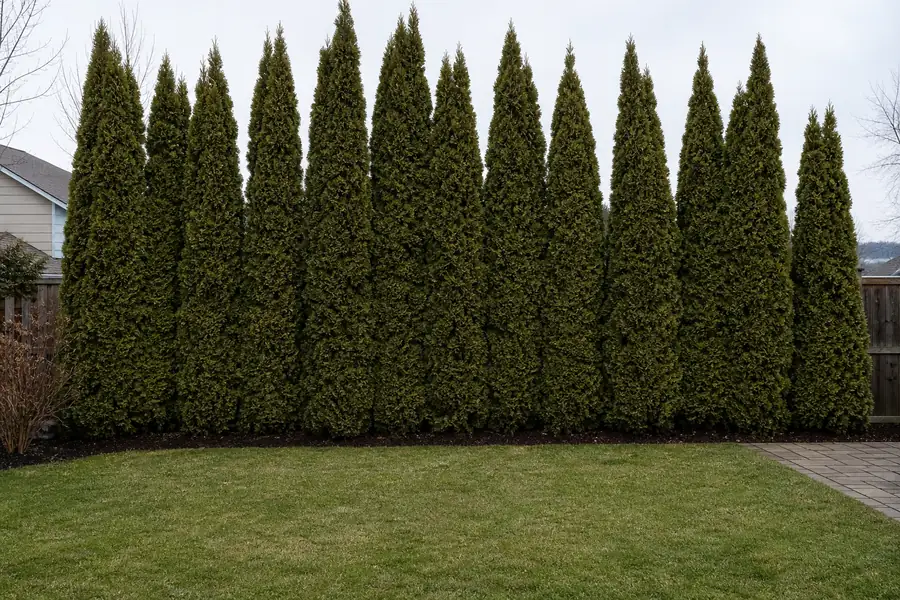
Arborvitae are the default privacy tree for a reason: they're dense, cold-hardy across most of the country, and come in sizes for almost any yard. Green Giant arborvitae reaches 30 to 40 feet tall and 12 to 15 feet wide, grows up to 3 feet a year once established, and handles zones 5 through 8. Space plants 5 to 6 feet apart for a solid wall of green.
Emerald Green arborvitae is the better fit for tighter lots. It tops out around 12 to 15 feet tall and only 3 to 4 feet wide, grows 6 to 9 inches a year, and is hardy from zones 3 through 7, making it one of the few privacy evergreens that shrugs off harsh northern winters.
Best Privacy Trees for Tall Screens
For a screen taller than a two-story house, Green Giant arborvitae is still a strong choice, but a few other species outperform it in specific climates. Nellie Stevens holly reaches 15 to 25 feet, holds dense foliage year-round, and thrives in zones 6 through 9 with better heat and humidity tolerance than most arborvitae.
Eastern white pine grows 50 to 80 feet tall in zones 3 through 8 and works well on large rural properties, though its width (20 to 40 feet) rules it out for smaller lots. Norway spruce reaches 40 to 60 feet in zones 3 through 7 and tolerates colder winters than most broadleaf evergreens, making it a dependable pick for northern screening.
Best Privacy Trees for Small or Narrow Yards
Narrow side yards and small lots need privacy trees that stay slim at maturity. Emerald Green arborvitae, already mentioned above, is the standard choice here. Spartan juniper is another option: it reaches 15 to 20 feet tall but only 3 to 5 feet wide, and handles zones 4 through 9 with good drought tolerance once established.
Italian cypress grows narrower still, staying 3 to 5 feet wide at 30 to 40 feet tall, but it only suits warm climates (zones 7 through 11) and needs sharp drainage. Sky Pencil holly is a slower, shorter option for anyone who wants a true columnar screen under 10 feet.
Best Privacy Trees for Shade
Most privacy evergreens want full sun, so shaded yards need a different short list. Canadian hemlock tolerates partial shade and grows well in zones 3 through 7, though it's worth watching for woolly adelgid, a small insect pest that has damaged hemlock stands in parts of the eastern US; extension-service monitoring guidance is widely available if you're planting in an affected region.
Yew is another shade-tolerant option, staying dense and slow-growing in low light. Skip laurel fills in faster under tree canopy in zones 6 through 9, though it struggles in hard freezes. None of these three match the growth rate of full-sun arborvitae, so plan on a longer timeline if your site is shaded.
Species to Think Twice About
Leyland cypress is sold everywhere as a fast privacy fix, and it does grow quickly. But it's prone to canker diseases and bagworm damage, and stands commonly decline or die within 15 to 20 years, well short of the decades most homeowners expect from a planted screen. Running bamboo has the opposite problem: it spreads aggressively through underground rhizomes and can invade neighboring yards, lawns, and gardens. Both look like shortcuts. Neither is the right tree for a permanent screen.
Spacing and Years to Privacy
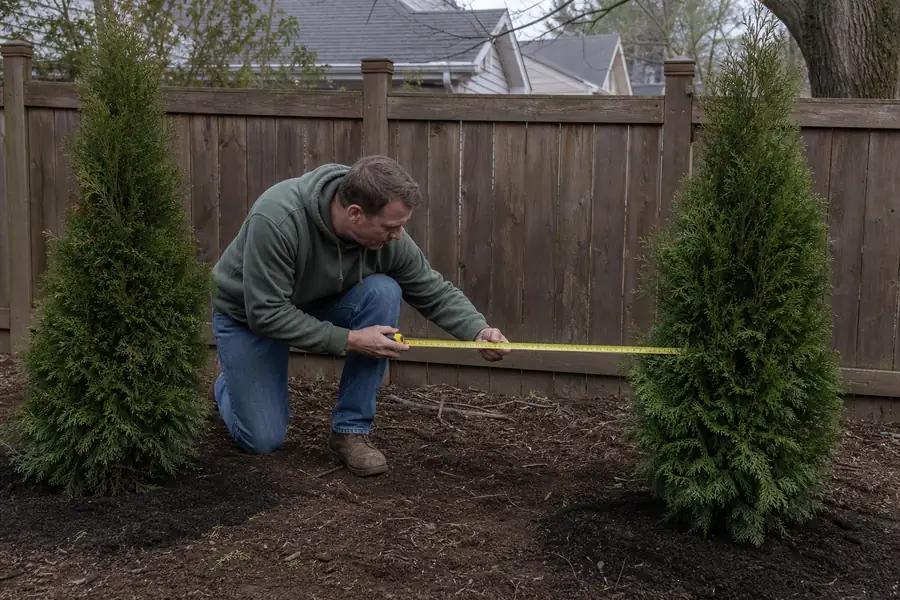
Spacing determines how fast a screen closes, and planting too far apart is the most common privacy-tree mistake. Green Giant arborvitae planted 5 to 6 feet apart typically forms a solid 12 to 15 foot screen in roughly 3 to 5 years, assuming healthy establishment and adequate water during that window. Our tree spacing calculator can work out exact plant counts for your run length and species.
Starting size shortens that wait more than growth rate does. A tree planted at 6 feet tall needs far less time to reach a usable screen height than one planted at 2 feet, even if both grow at the same rate per year. If you want privacy sooner rather than later, buying larger landscape-grade stock and browsing evergreen privacy trees sized for faster coverage is the more reliable lever to pull.
Privacy Tree Comparison Table
Use mature width, not just height, as your first filter when scanning this table; it's the number most buyers overlook.
| Tree | Mature H x W | Spacing | Growth/yr | USDA Zones | Best For |
|---|---|---|---|---|---|
| Green Giant Arborvitae | 30-40 x 12-15 ft | 5-6 ft | Up to 3 ft | 5-8 | Tall fast screens |
| Emerald Green Arborvitae | 12-15 x 3-4 ft | 3-4 ft | 6-9 in | 3-7 | Narrow spaces |
| Nellie Stevens Holly | 15-25 x 10-12 ft | 6-8 ft | 1-2 ft | 6-9 | Tall screens, berries |
| Eastern White Pine | 50-80 x 20-40 ft | 10-15 ft | 1-2 ft | 3-8 | Large properties |
| Norway Spruce | 40-60 x 25-30 ft | 10-12 ft | 1-2 ft | 3-7 | Cold climates |
| Spartan Juniper | 15-20 x 3-5 ft | 3-5 ft | ~1 ft | 4-9 | Narrow lots |
| Italian Cypress | 30-40 x 3-5 ft | 4-6 ft | 2-3 ft | 7-11 | Narrow, warm zones |
| Canadian Hemlock | 40-70 x 25-35 ft | 8-10 ft | 1-2 ft | 3-7 | Shade screens |
Every tree Arbor Buddy ships is rated to the zones it actually survives in, flagged against your ZIP code before you buy, and backed by Arbor Buddy's 1-Year Alive & Thrive Guarantee. If a zone-matched privacy tree doesn't make it through its first year, we'll replace it.
FAQs
What is the fastest-growing privacy tree?
Green Giant arborvitae is among the fastest, adding up to 3 feet of height a year once established in zones 5 through 8. Leyland cypress grows at a similar pace but carries higher disease risk, so Green Giant is usually the sturdier fast option for a lasting screen.
Evergreen or deciduous for privacy?
Evergreen trees are the better default for privacy screening because they hold their foliage through winter, when a bare deciduous tree offers no coverage at all. Deciduous trees can still add summer shade and seasonal interest, but they shouldn't be your only screening layer.
How far apart do I plant privacy trees?
Spacing depends on the tree's mature width: most arborvitae go 3 to 6 feet apart, while wider-spreading trees like Eastern white pine need 10 to 15 feet between trunks. Planting too close saves time at first but leads to crowding, disease, and lopsided growth within a few years.
Which privacy trees are deer-resistant?
Spruce, boxwood-adjacent hollies like Nellie Stevens, and most junipers are among the more deer-resistant evergreen choices, though no plant is fully deer-proof in a hard winter. Arborvitae, by contrast, is a known deer favorite and often needs protection in high-pressure areas; see our guide on protecting trees from deer for specific tactics.
How long until privacy trees fill in?
Most evergreen screens planted at a reasonable landscape size take 3 to 5 years to form a solid, continuous wall of foliage. Starting with larger, more established trees shortens that timeline noticeably, since you're beginning closer to the finished height and width you want.