
Quick answer: Add the mature spreads of two neighboring trees and divide by two: that gives you the on-center distance for full, separate canopies. Want a solid privacy screen instead? Use 50 to 75 percent of the mature spread, tighter for a dense hedge, looser for airflow. A tree spacing calculator just runs this math for you.
Most spacing advice online gives you one number, like "plant trees 20 feet apart," and stops there. That's bad advice dressed up as simple advice: a columnar evergreen and a wide-canopied oak have nothing in common, and a dwarf cultivar needs a fraction of the room its full-size parent species does. The formula below works off the actual mature spread of your specific trees, not a guess.
The Tree Spacing Calculator Formula
Specimen spacing is (mature spread of Tree A plus mature spread of Tree B) divided by 2, measured on-center, meaning trunk to trunk rather than edge to edge of the canopy. That distance gives two trees enough room to reach full size without their crowns crowding each other out.
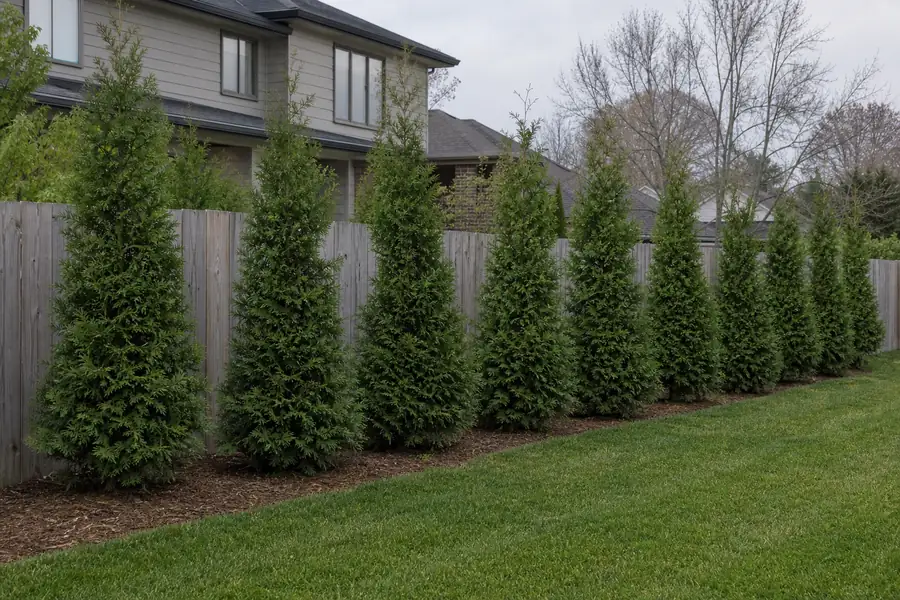
Screen spacing uses a different multiplier, because the goal is for canopies to meet, not stay separate. Multiply the mature spread by 0.5 to 0.75: 0.5 for a tight, solid hedge, 0.75 if you want a slightly looser screen with better airflow.
Example: a Bur Oak with a 60-foot spread planted next to a Chinkapin Oak with a 50-foot spread needs (60+50)/2, or 55 feet on-center, for both to reach full size without competing. A row of Emerald Green arborvitae, each with a 3 to 4-foot spread, works out to roughly 2 to 3 feet apart on-center for a solid wall of green.
Mature spread also shifts with climate, so run your ZIP code through Arbor Buddy's growing zone lookup before you commit to a number, since a tree pushed by a longer growing season can outgrow the spread listed for a colder region.
Building Your Own Spacing Calculator
A working spacing calculator needs just two inputs: the mature spread of each tree, or a species preset pulled from a database, and your goal, specimen planting or privacy screen. The output is a single on-center distance in feet, with a warning if the number you enter falls below the screen minimum for that species.
If you're sanity-checking the math by hand, or reading this without the interactive version loaded, the table below works as a static fallback. Match your tree type to a row and you have a spacing range without touching a keyboard.
Quick Reference Table for Common Trees
Mature spread varies by cultivar and by climate, so check mature spreads for your zone before locking in a number. A tree grown in a mild, long-season climate can outgrow the spread listed for a colder region.
| Tree type | Mature spread | Specimen spacing | Screen spacing |
|---|---|---|---|
| Large shade trees (oak, maple; zones 3-9 by species) | 40-60 ft | 40-50 ft | Not typically screened |
| Medium trees (redbud, ornamental pear) | 25-40 ft | 25-30 ft | 20-30 ft |
| Small ornamentals (crape myrtle, dogwood) | 15-25 ft | 15-20 ft | 10-15 ft |
| Emerald Green arborvitae (zones 3-7) | 3-4 ft | Not used as specimen | 3-4 ft |
| Green Giant arborvitae (zones 5-8) | 12-20 ft | Not used as specimen | 5-8 ft |
Staggered Double Rows for a Fuller Screen
A staggered double row solves the tension between density and tree health: offset two rows so each tree in the back row sits in the gap between two trees in the front row. From the street, the canopies overlap and read as one solid wall.
Underground and up top, each trunk still gets more breathing room than a single tight row allows. Space the rows themselves 3 to 6 feet apart depending on species, and keep on-center spacing within each row close to the screen minimum from the table above. Columnar evergreens are especially good candidates for this pattern, since their narrow, upright habit lets a staggered row fill in fast without any one tree hogging the light.
Why Tight Tree Spacing Fails
Trees planted too close together compete for the same light, water, and root space, and every tree in the group loses ground at once. Crown competition thins interior growth first, since branches that can't reach open light stop producing leaves. Airflow drops next, which raises humidity inside the canopy and, with it, disease and fungal pressure.
Below ground, roots from crowded trees tangle and compete for the same limited water and nutrients, so even a well-watered yard can leave every tree undersized and stressed. Hedges are the deliberate exception: a formally sheared hedge is trained to stay small and dense on purpose, with regular pruning doing the job that space would otherwise do. Plant an unclipped shade tree at hedge spacing and you get a stunted, weak tree instead of a hedge.
It's worth saying plainly: correctly spaced young trees look almost absurdly empty on planting day. That gap is doing its job. Give it five to ten years and the canopies close the distance on their own, and you'll be glad you didn't crowd them for the sake of an instant look.
Spacing Trees from Structures
Foundations need 8 to 30 feet of clearance depending on a tree's mature size, small ornamentals at the low end, large shade trees at the high end, and pavement needs 3 to 12 feet to keep roots from heaving sidewalks and driveways. Whatever spacing you land on between trees, plant each tree correctly, at the right depth and distance from structures, so the roots you're spacing for actually establish the way the formula assumes.
Overhead clearance matters just as much as what's underground. If you're planting anywhere near utility lines, give the mature canopy width extra room on the side facing the lines, since a tree that fits your ground-level spacing plan can still grow straight into a line overhead.
FAQs
How far apart should shade trees be planted?
Large shade trees like oak and maple typically need 40 to 50 feet of on-center spacing, since their mature spread often runs 40 to 60 feet. For two different species planted side by side, add both mature spreads and divide by two.
How far apart should I plant trees for a privacy screen?
Emerald Green arborvitae generally needs 3 to 4 feet of on-center spacing for a solid screen, while a larger grower like Green Giant arborvitae needs 5 to 8 feet. For any other screening species, multiply the mature spread by 0.5 to 0.75.
I planted my trees too close together. What now?
Thin them while they're still young by removing the weaker of two crowded trees before the root systems get too tangled to separate cleanly. Moving an established tree is expensive and stressful for the tree, so correcting crowding early gives the remaining trees the best odds of thriving.
Does staggering rows actually save space?
Staggering doesn't save ground area so much as it builds a fuller-looking screen in a similar footprint. Offsetting two rows lets each tree fill the gap left by its neighbor in the other row, so the screen reads as solid sooner without planting everything shoulder to shoulder.
Does mature spread differ between dwarf and full-size versions of the same tree?
Yes, often dramatically. A dwarf cultivar can top out at a third of the spread of its full-size parent species, so always check the spread listed for the specific cultivar you're buying, not just the species name, before you calculate spacing.