

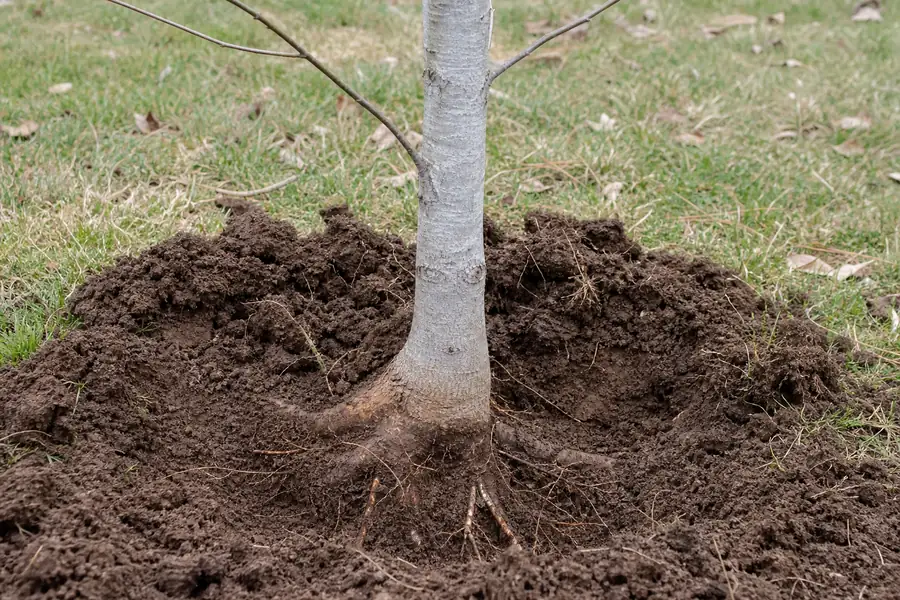
The root flare is the point at the base of a tree where the trunk widens and the topmost structural roots leave it. It is the boundary between the part of the tree built to live in air and the part built to live in soil, and it should always be visible. When soil or mulch covers it, the tree begins a slow decline that often takes more than a decade to become obvious - by which point it is usually too late to reverse.
Key takeaways
- You should be able to see the flare on every healthy, correctly planted tree. If a trunk enters the ground like a post, something is covering it.
- The flare is the reference point for planting depth, not the top of the root ball or the soil line in the pot.
- Burying it causes stem-girdling roots, which Colorado State Extension calls "the most common cause of tree decline and death in the landscape."
- The damage surfaces late - typically "twelve to twenty plus years after planting."
- On an established tree, exposing a buried flare is often worth doing, and is a different job from re-planting.
What the flare actually is
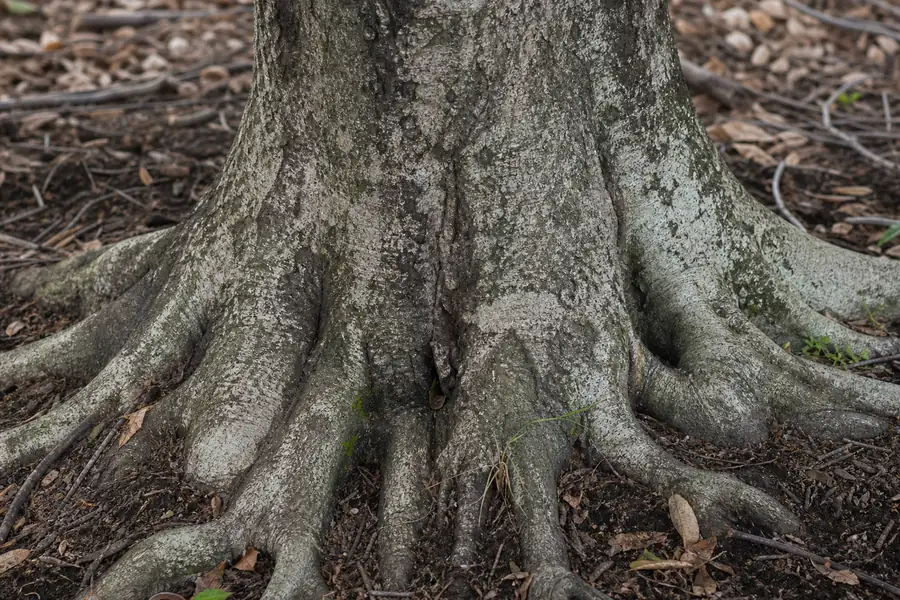
Walk up to an old tree growing in a field and look at its base. The trunk does not meet the ground at a right angle. It widens, splays, and divides into buttresses that run out into the soil. That widening is the root flare - also called the trunk flare or the root collar.
It exists because of how a tree carries load. The base of a trunk is the most heavily stressed point on the whole structure: every wind force on the canopy is transferred into the ground there. The flare is the tree's engineering response, a gradual transition rather than an abrupt joint.
It also marks a change in tissue. Trunk bark is built for air - it handles drying, sun and temperature swings, and it is not adapted to constant moisture. Root tissue is the opposite. The flare is where one becomes the other, and that is why covering it matters: you put air-adapted tissue into a permanently moist environment.
Flare, root collar, root crown - same thing?
In everyday use, yes, and the sources use them interchangeably. UF/IFAS writes: "This point is called the trunk flare, root flare or root crown." Some arborists draw finer distinctions, but for planting and diagnosis they refer to the same region at the base of the trunk.
How to find the flare on your tree
On a tree you are about to plant
- Leave it in its pot or ball and set it somewhere you can work around.
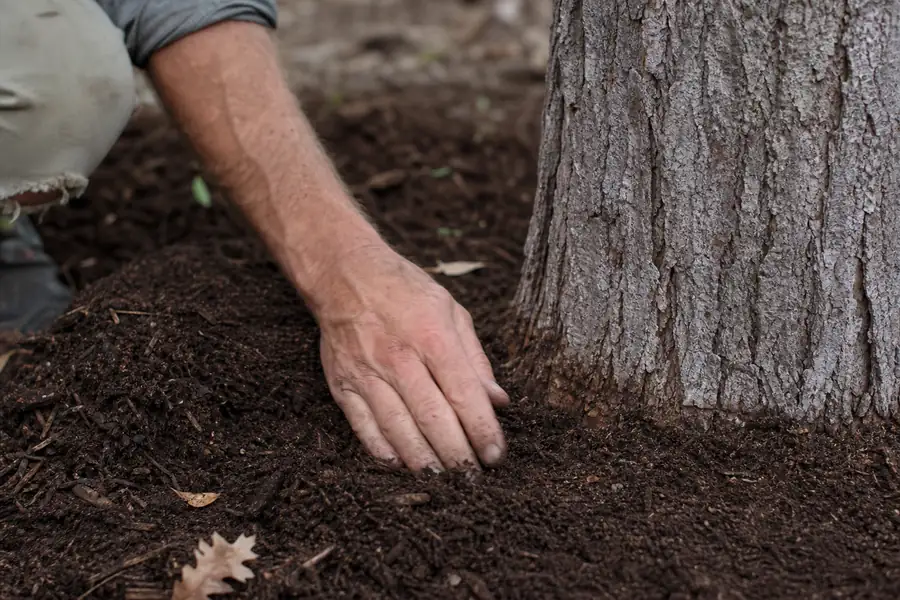
- Scrape soil away from the trunk with your fingers, a hand cultivator or a gentle hose.
- Stop when the trunk visibly widens and you can see where the first large root leaves it.
- Note how deep you had to go. That is your depth correction.
ISA's instruction is to do this before planting: "Remove excess soil prior to planting if flare is not visible."
On a tree already in the ground
The five-second version: stand back and look at the base. A correctly planted tree looks like a foot in a shoe - it widens where it meets the ground. A tree with a buried flare looks like a pole driven into soil.
The confirming check: scrape gently at the trunk, just below the soil surface. If you find bark, the flare is deeper. If you find a root leaving the trunk sideways, you have found it.
Work carefully, use hands or a blunt tool near the trunk, and stop as soon as you reach the flare.
Why burying it is so damaging
Four things happen at once, and all of them are slow.
1. Bark decays
Trunk bark held against wet soil stays wet. Over years, the protective outer layer breaks down, and the conductive tissue beneath becomes vulnerable to decay organisms and canker fungi. The wound is invisible because it is underground.
2. Roots are pushed out of the oxygen zone
Roots need oxygen. Colorado State puts roughly 50% of absorbing roots in the top 12 inches in soil with good tilth, and 90-95% of the entire root system in the top 12 inches or less in compacted or clay soil - with half of the absorbing roots in the top four inches. Adding six inches of soil over the flare moves a large proportion of a tree's working roots into a layer with much less available oxygen.
3. New roots circle instead of spreading
This is the mechanism that actually kills trees. A root emerging from a trunk that is surrounded by soil on all sides has no outward cue. It grows around the trunk instead of away from it.
Years later, the circling root has thickened. So has the trunk. They meet, and the root compresses the trunk's conductive tissue from the outside - a tourniquet that tightens by a fraction of an inch a year.
4. The tree looks thirsty, so people water it
A girdled or oxygen-starved tree produces small leaves, thin canopy and early autumn color - the same signs as drought stress. The intuitive response makes the underlying problem worse.
The symptoms, in the order they appear
| When | What you see |
|---|---|
| At planting | No visible flare; trunk enters soil straight |
| Years 1-3 | Often nothing. The tree looks fine |
| Years 3-8 | Growth slows; leaves smaller than they should be; thin crown |
| Years 5-12 | Early fall color, premature leaf drop, tip dieback on upper branches |
| Years 10-20 | A visible flat spot or indentation on one side of the trunk base, sometimes with a root crossing it |
| Years 12-25 | Rapid decline, or failure at the base in a storm |
The flat spot is the giveaway. A trunk should be round in cross-section at the base and should flare outward. A trunk that is flattened or pinched on one side, especially with a root visible across that face, is being girdled.
Exposing a buried flare on an established tree
This is routine arboricultural work, and it is often worth doing. It is not the same as replanting - you are removing soil, not moving the tree.
The method
- Work outward from the trunk, removing soil until the flare and the tops of the first structural roots are exposed.
- Use hands, a blunt hand tool, or water from a hose. Professionals use compressed-air soil tools because they remove soil without cutting roots. Do not swing a sharp spade near the trunk.
- Shape the result as a gentle saucer that drains away from the trunk. A pit that holds water against the bark has traded one problem for another.
- Keep mulch outside the exposed area, 2-3 inches deep, never against the trunk.
- Water normally afterwards. The tree has not lost roots, so it does not need transplant-style aftercare.
Where to stop and call someone
- You find a root already pressed against or compressing the trunk. Removing a large girdling root can destabilize the tree and sometimes removes more conductive tissue than it saves. That is a judgment call requiring an in-person assessment.
- The tree is large, close to a structure, or already showing significant dieback.
- You hit heavy root mass and cannot tell what is root and what is trunk.
A consulting or certified arborist can assess girdling severity and whether removal is likely to help. ISA maintains a public directory of credentialed arborists.
Mulch volcanoes do the same damage, faster to fix
Piling mulch against a trunk creates exactly the conditions of a buried flare: constantly moist bark, roots encouraged into the mulch layer where they circle, and a hidden trunk base.
The difference is that mulch comes off in minutes. If you take one action from this page, walk outside and pull mulch back from every trunk on your property until you can see the flare.
ISA specifies a mulch-free area of 1-2 inches wide at the base of the tree; UF/IFAS recommends a 12-inch gap. Either way, the number is not zero. See how to mulch around a tree.
The flare and nursery stock
The American Standard for Nursery Stock (ANSI Z60.2-2025) assumes the flare is at the surface. It defines caliper measurement for container stock as taken "from the soil line... which should be at or near the top of the root flare" - and the same for height.
In practice, potting mix settles and growers top it up, so container stock often arrives with the flare an inch or several below the surface. That is worth knowing for two reasons: it tells you to check before planting (how deep to plant a tree has the method), and it means a tree advertised as a given height may be measured from a soil line that is not where the standard intends.
FAQ
Should the root flare be above or below ground?
At ground level or slightly above it, with the widening visible. UF/IFAS: "should be even with, or slightly above, the soil surface." It should never be below.
How much of the root flare should show?
Enough that you can see the trunk widen and the tops of the first structural roots. ISA's wording is that the flare should be "partially visible" after planting. You are not excavating a sculpture - you are keeping bark out of wet soil.
My tree has no visible flare at all. Is it definitely planted too deep?
Not definitely, but it is the most likely explanation, with piled mulch second. A few species have naturally subtle flares when young. Scrape gently at the trunk: if you reach a root leaving the trunk within an inch or two, it is fine. If you find bark going down and down, it is buried.
Can exposing the flare damage the tree?
Done carefully, no - you are removing soil, not roots. Risk comes from cutting roots with a sharp tool, exposing roots and then leaving them bare in full sun, or creating a basin that holds water against the trunk. Work with hands or water near the trunk, and shape the finish to drain outward.
Is a girdling root always fatal?
No. Caught early, when the root is small, removal is often straightforward and the tree recovers. A large root that has already deformed the trunk is a different matter, and cutting it is sometimes worse than leaving it. That decision needs a professional.
Do palms have a root flare?
No, not in the way broadleaf and coniferous trees do. Palms are monocots with a fibrous root system emerging from a root initiation zone at the base, and they are planted differently. Nothing in this article about flares applies to palms.
Checking the flare takes two minutes and prevents the most common cause of landscape tree failure. Every tree in our catalog is matched to your climate through the zone finder and backed by our 1-Year Thrive Guarantee.