

Apply 2 to 3 gallons of water per inch of trunk diameter every time you water - so a 2-inch caliper tree gets 4 to 6 gallons per irrigation. For trees planted in spring or summer, water two to three times a week for the first few months, then weekly until the tree is established. The volume stays the same; it is the frequency you adjust for weather, soil and season. How long you keep this up depends on your hardiness zone as much as on the tree: establishment runs roughly three months per inch of caliper in zone 10 and about twelve months per inch in zone 4.
Key takeaways
- Water by trunk diameter, not by the calendar. 2-3 gallons per inch of trunk diameter, every watering (UF/IFAS).
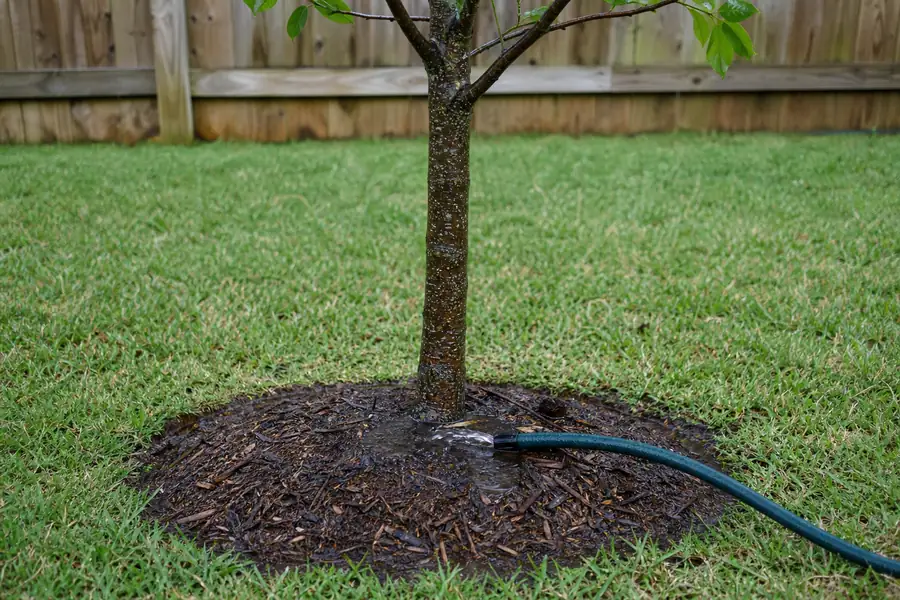
- Water the root ball, not the lawn around it. For the first months, almost all of the tree's working roots are still inside the ball it arrived in.
- Slow beats fast. Water applied faster than the soil absorbs it runs off.
- Never water a saturated root ball. Overwatering and drought look nearly identical from above.
- Check the soil with your finger before every watering. It is the only reliable test.
- Establishment is zone-dependent - the same tree needs four times as long in Minnesota as in South Florida.
How much: the formula
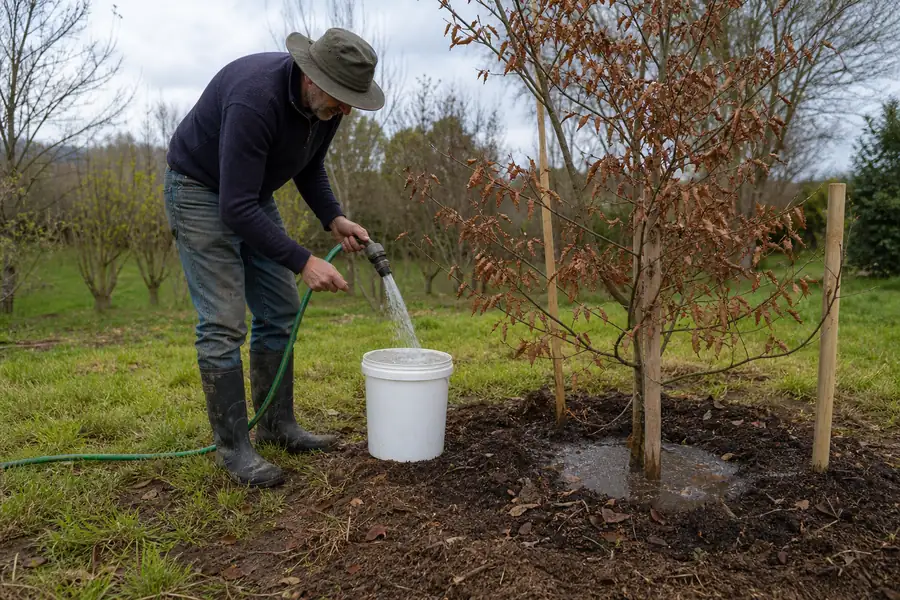
2 to 3 gallons per inch of trunk diameter, per irrigation. UF/IFAS states it directly: "Irrigations should be 2 to 3 gallons of water per inch trunk diameter. For example, a 2-inch tree should be watered 4 to 6 gallons each irrigation."
To use it, measure the trunk diameter six inches above the root flare.
| Trunk diameter | Water per irrigation |
|---|---|
| ½ inch | 1-1.5 gallons |
| 1 inch | 2-3 gallons |
| 1½ inches | 3-4.5 gallons |
| 2 inches | 4-6 gallons |
| 3 inches | 6-9 gallons |
| 4 inches | 8-12 gallons |
If your tree is young enough to be sold by height rather than caliper, estimate: a 6-8 ft shade tree is typically around ¾-inch caliper, and a 10-12 ft one around 1½ inches, per the ANSI nursery stock size relationships. Tree sizes explained has the full table.
A note on a figure you will see elsewhere: "10 gallons per inch of caliper" circulates widely online. It is not what the Extension sources specify, and on a small tree in heavy soil it is enough to cause problems. The 2-3 gallon figure above is the sourced one.
How often: the schedule
Frequency is what changes. Here is the baseline for a spring or summer planting:
| Period after planting | Frequency | Notes |
|---|---|---|
| First 1-2 weeks | Every 2-3 days | The root ball dries faster than the surrounding soil |
| Weeks 3-12 | 2-3 times per week | UF/IFAS: two irrigations weekly in cooler zones, three in warmer |
| After the first few months | Weekly | ISA's baseline: at least once a week, barring rain |
| Until established | Weekly, through every dry spell | See the establishment table below |
| After establishment | Only in drought | Deep, infrequent watering |
Then adjust:
| Condition | Adjustment |
|---|---|
| Sandy, fast-draining soil | More often, same volume |
| Heavy clay | Less often - clay holds water, and overwatering clay is a real risk |
| Hot, windy weather | More often. ISA specifically flags hot, windy conditions |
| Cool, overcast, humid | Less often |
| Fall or winter planting in a mild zone | Much less often - but do not stop. Evergreens in particular lose water all winter |
| Heavy rain | Skip, if it actually wet the root ball. Dig and check |
The single most common watering error is frequency drift in the wrong direction - watering a little every day with a hose for two minutes. That wets the mulch and the top inch of backfill and never reaches the root ball.
Where to put it
This is the part most guides skip, and it matters more than the schedule.
For the first few months, your tree's working roots are almost entirely inside the root ball it arrived with - a volume perhaps 16 to 24 inches across. The backfill around it is still mostly empty of roots. Water applied to a wide circle around the tree largely misses the tree.
- Months 1-3: apply water directly over the root ball, slowly.
- Months 4-12: widen to cover the root ball and the backfilled planting area, as roots move outward.
- Year 2 onward: widen again toward the drip line and beyond.
Delivery methods
| Method | Good for | Watch out for |
|---|---|---|
| Hose on a slow trickle, timed | Accurate volume, cheap | You have to be there; easy to forget |
| 5-gallon bucket with small holes drilled low | Precise volume, slow release, free | Refilling by hand |
| Soaker hose coiled over the root ball | Even, slow | Hard to know the volume actually delivered |
| Drip emitters on a timer | Consistency | Must be positioned over the root ball, not the backfill edge |
| Watering bags | Slow release, convenient | Can keep bark constantly wet; move or remove periodically. Not stocked by Arbor Buddy |
| Lawn sprinkler | Nothing, for this purpose | Wets foliage and lawn; almost never delivers enough to a root ball |
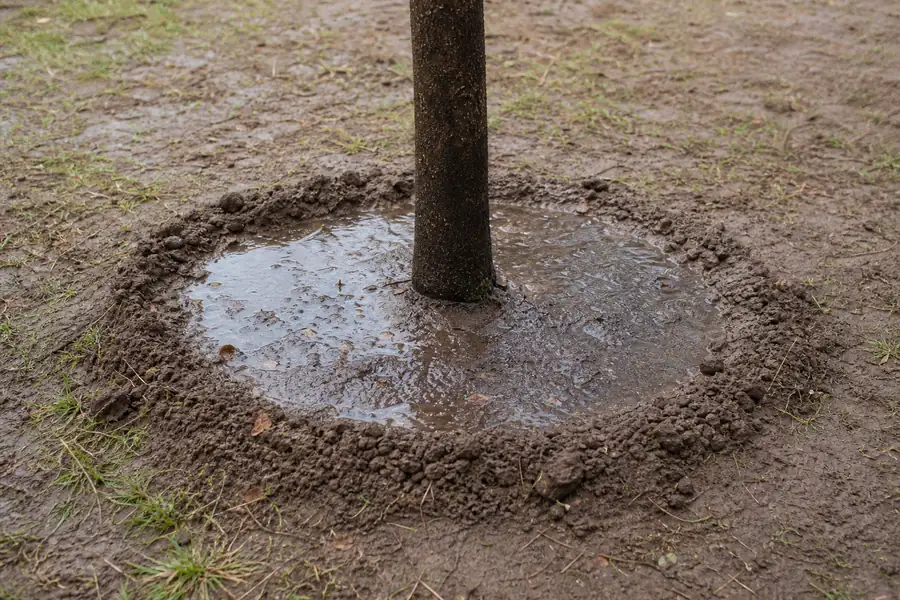
A berm of soil around the edge of the planting hole for the first season holds water over the root zone instead of letting it run off. Remove it after year one so it does not become a basin against the trunk.
The finger test, and why you need it
Before every watering, push a finger - or a screwdriver, or a soil probe - 4 to 6 inches into the soil at the edge of the root ball.
| What you find | What to do |
|---|---|
| Dry and crumbly | Water now |
| Slightly moist, cool | Wait a day, check again |
| Wet, soil sticks together and smears | Do not water. Check again in 2-3 days |
| Standing water or a sour smell | Stop watering entirely and check drainage |
UF/IFAS is explicit that you should never add irrigation if the root ball is already saturated.
Telling overwatering from underwatering
They look alike. Both produce wilting, both produce leaf loss, and the intuitive response to both is to water more - which only fixes one of them.
| Sign | Underwatered | Overwatered |
|---|---|---|
| Leaves | Wilt, then crisp and brown at edges and tips | Wilt while staying soft; yellow, often from the inside of the canopy out |
| Leaf drop | Dry leaves, often curled | Green or yellow leaves drop while still soft |
| Soil at the root ball | Dry 4-6 inches down; may pull away from the ball | Wet, heavy, smells sour or stagnant |
| Timing | Worst in afternoon heat, partial overnight recovery | Constant, does not recover overnight |
| New growth | Small, slow | Soft, pale, sometimes none at all |
Midday wilting in high heat is not automatically a water problem. Many species wilt in afternoon sun and recover by evening. Judge by the soil and by how the tree looks in the morning.
How long do you have to keep doing this?
Until the tree is established - meaning it has regrown enough root system to supply itself. That is not a fixed period, and the difference between regions is large.
| Your USDA zone | Establishment per inch of trunk caliper | A 2-inch tree |
|---|---|---|
| 10-11 | ~3 months | ~6 months |
| 8-9 | ~4 months | ~8 months |
| 6-8 | ~8 months | ~16 months |
| 2-5 | ~12 months | ~2 years |
Figures from Dr Edward Gilman's work at UF/IFAS. The widely used general rule from Watson's research - at most one year per inch of caliper - sits at the conservative end of the same range.
Root growth is driven by soil temperature, and warm regions simply have more root-growing days each year. If you do not know your zone, the ZIP code tool will tell you.
Even after establishment, the South Carolina Forestry Commission notes that regular care matters through the first three years following transplanting. A deep soak during drought is worth it well beyond the formal establishment period.
Why it takes so long
When a field-grown tree is dug, more than 95% of its absorbing roots are severed. A 1-inch caliper tree has a root system roughly 4.5 feet across and leaves the nursery with a root ball about 1.5 feet across. The canopy is full size; the plumbing is not. That gap is transplant shock, and watering is how you carry the tree across it.
Season by season, first year
| Season planted | What is different |
|---|---|
| Spring | Easiest. Full growing season to establish. Follow the schedule above, and expect to water hardest through the first summer |
| Summer | Highest-risk planting season. Front-load frequency, check soil every other day in heat, and consider temporary shade in the hottest zones |
| Fall | Reduce frequency as temperatures fall, but do not stop. Roots keep growing until soil drops below about 40°F. Water deeply before the ground freezes |
| Winter (mild zones) | Water during dry, warm spells. Evergreens continue losing moisture through their foliage all winter |
Winter desiccation is a common and avoidable failure in cold zones: the foliage of evergreens keeps transpiring while the soil is frozen and roots cannot resupply. A deep soak before the ground freezes, and mulch to moderate soil temperature, both help.
FAQ
How much water does a newly planted tree need?
2 to 3 gallons per inch of trunk diameter at every watering, per UF/IFAS. A 2-inch caliper tree needs 4 to 6 gallons each time.
How often should I water a newly planted tree?
Every 2-3 days for the first couple of weeks, then 2-3 times a week for the first few months if planted in spring or summer, then weekly until established. Adjust frequency - not volume - for soil, heat and rainfall.
Can you overwater a newly planted tree?
Yes, and it is one of the most common causes of failure, particularly in clay soils. Saturated soil has no oxygen and roots cannot function. Check soil moisture before every watering and skip it if the root ball is already wet.
Does rain count?
Only if it was heavy enough to wet the root ball. Light rain wets mulch and foliage and nothing else. Dig down 4 inches at the edge of the root ball and check before skipping a watering.
Should I use a watering bag?
They deliver water slowly, which is their advantage, and they remove the need to stand there with a hose. The trade-off is that they keep the trunk base constantly moist and can conceal what is happening underneath. If you use one, move or remove it periodically and check the bark. Arbor Buddy does not sell them.
When can I stop watering?
When the tree is established - see the zone table above - and after that only during drought. Expect to keep an eye on it through its first three years regardless.
Should I fertilize while establishing?
No. ISA advises against fertilizing at the time of planting, and a newly planted tree is short of roots, not nutrients. If you suspect a genuine deficiency, get a soil test through your county Extension office and act on the result in year two. See the best soil for planting trees.
My tree's leaves are wilting even though the soil is wet. What is wrong?
Almost certainly too much water, not too little. Saturated soil suffocates roots, which stops water uptake, which makes the tree wilt - the symptom of drought with the opposite cause. Stop watering, check drainage, and read transplant shock.
Watering is the single biggest factor in whether a new tree survives its first year - which is why every tree we ship carries a 1-Year Thrive Guarantee. Choosing a species matched to your rainfall and soil helps too: start with the zone finder.