
Planting & Care
Staggered Privacy Tree Planting: Single Row vs Staggered Double Row Layouts

Quick answer: A single row of evergreens is the cheapest, narrowest layout and works fine for most residential property lines. Staggered privacy tree planting, using two offset rows, gives a denser, gap-free screen and a backup if one tree dies, but it needs roughly twice the width and more plants to pull off.
Which one you need comes down to how much width you have to give up and how airtight the screen has to be. A side yard that's eight feet wide can't fit a double row no matter how much privacy you want. A wide back line with road noise or a busy neighbor behind it is exactly where the extra plants earn their keep. If you haven't settled on a species yet, the privacy trees guide is a good place to start before you lock in spacing.
Single Row Layout: Spacing by Species
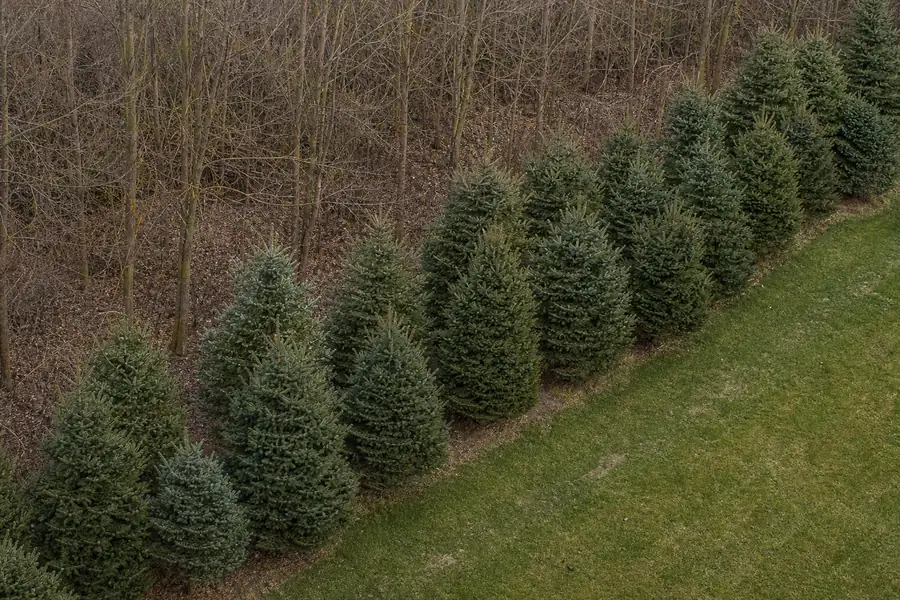
A single row hedge is one line of evergreens spaced on-center by species, and it's the lowest-cost, narrowest option for blocking a view along a property line. On-center spacing means measuring from the trunk of one tree to the trunk of the next; it's the standard way nurseries and extension offices talk about hedge spacing because it accounts for the full mature width, not just the size of the tree the day it's planted.
Spacing has to match mature width or the hedge either stays gappy for years or crowds itself into a tangled mess. Here's how that plays out for common screening evergreens:
| Species | Mature Width | Single-Row Spacing (on-center) |
|---|---|---|
| Thuja Green Giant | 12-20 ft | 5-6 ft |
| Emerald Green Arborvitae | 3-4 ft | 3-4 ft |
| Leyland Cypress | 15-20 ft | 6-8 ft |
| Nellie Stevens Holly | 10-15 ft | 5-6 ft |
A single row closes into a continuous screen more slowly than a double row, and it has no backup. If one tree in the line dies or stalls out, you get a visible hole until it's replaced and catches up. That's the trade-off for the lower plant count and the narrower footprint.
Staggered Privacy Tree Planting: The Double Row Layout
Staggered privacy tree planting places two rows of evergreens side by side, with the trees in the second row offset, or shifted, so they sit opposite the gaps in the first row instead of directly behind them. That offset is what makes the layout work: seen from the front, every sightline through the first row runs straight into a tree in the second row instead of open space.
The result is a denser, gap-free screen than a single row can give at the same age, plus a built-in backup. Lose a tree in one row and the other row still holds the line while the replacement grows in. A staggered double row also does double duty as a windbreak, a layout dense enough to slow and redirect wind rather than funnel it through gaps, which matters if the hedge is also buffering street noise or exposed to open fields.
Staggered Spacing Math: Planning the Offset
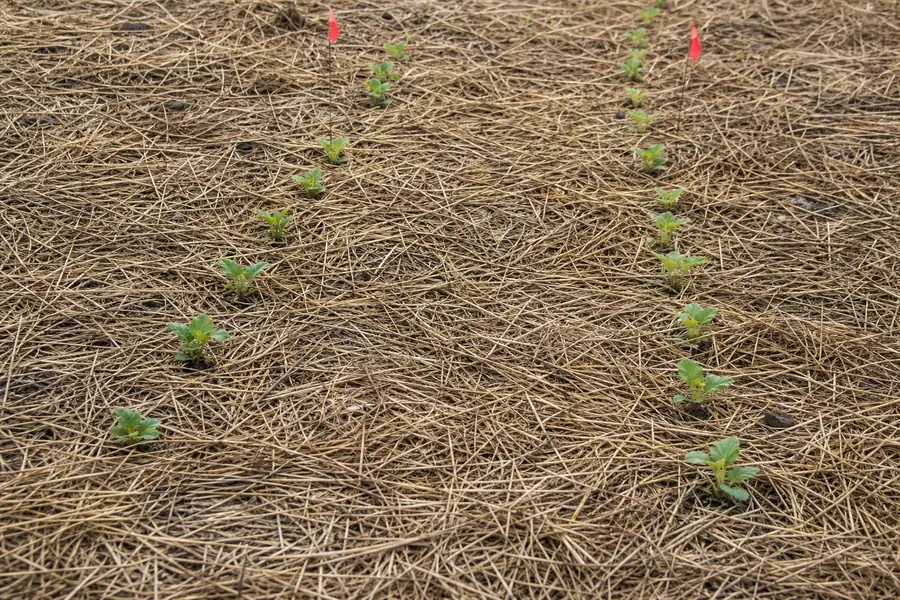
A workable staggered layout starts with three numbers: the distance between the two rows, the in-row spacing within each row, and the offset between them. Using Thuja Green Giant as an example, a typical setup runs the rows 4 ft apart, spaces plants 6-8 ft on-center within each row, and shifts row two by half that in-row spacing, roughly 3-4 ft, so each tree lines up with the midpoint gap in the opposite row.
| Measurement | Typical Value | What It Does |
|---|---|---|
| Row-to-row spacing | 3-4 ft | Keeps rows close enough to overlap canopies, not so close roots compete hard |
| In-row spacing | 6-8 ft on-center | Matches mature width so each row closes on its own |
| Offset | Half the in-row spacing (3-4 ft) | Puts row two's trees opposite row one's gaps |
Get the offset wrong and you lose the whole point of staggering. Shift row two by less than half the in-row spacing and the two rows end up fighting for the same light with no gap-filling benefit. The Green Giant spacing guide walks through the single-row numbers in more depth if that's the species you're planting. For a sense of the timeline, most staggered rows take a couple of growing seasons to close visually; the tree growth timeline guide covers how long that fill-in generally takes by size and species.
Single Row or Double Row: Which Fits Your Yard
A single row is the right call for tight side yards, HOA setback limits, and budgets that need to cover more linear feet with fewer plants. It's also the practical choice any time the available width can't comfortably fit two rows plus the mature spread on either side without the hedge swallowing the walkway or crowding the fence.
A staggered double row earns its extra cost and footprint when the privacy need is serious: a busy road behind the yard, a neighbor's second-story window with a direct sightline, or a windbreak that also has to screen a view. It's also worth the investment anywhere a single dead tree would be a real problem, since the second row covers for it while a replacement catches up.
- Choose single row: narrow strips, budget-driven projects, low-risk sightlines
- Choose staggered double row: wide back lines, road or wind exposure, zero tolerance for gaps
- Skip double row when: the site can't fit the width, or a single row already does the job
Layout Tips for Any Hedge Row
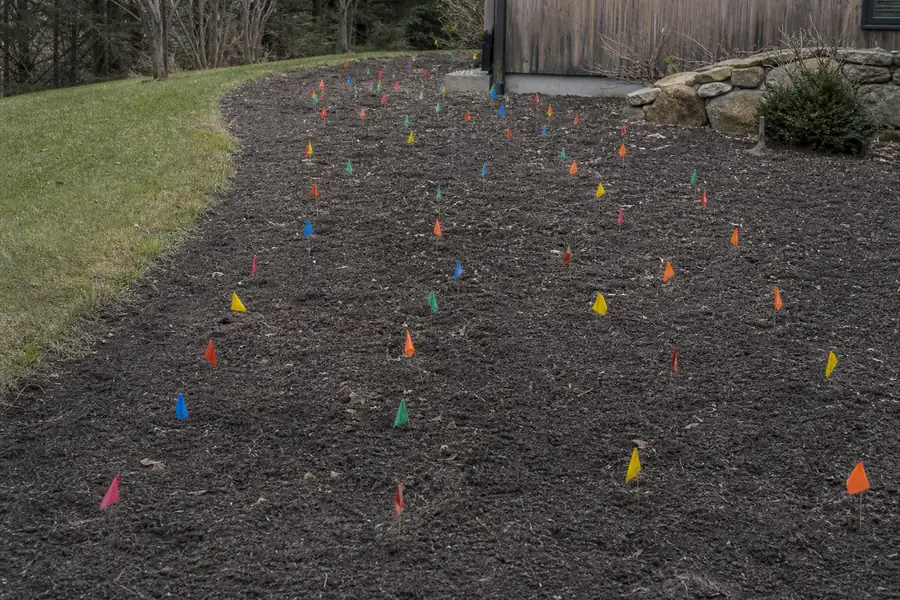
Set the row back from fences and property lines by at least half the mature spread, plus a couple of feet of working room. Plant a Green Giant that spreads 15 ft wide right on the line, and half of it legally and physically ends up on someone else's side.
Call before you dig. Underground utilities and overhead lines both rule out certain spots, and a staggered double row doubles the trenching to check. Curving the row or running it along a gentle berm also reads as more intentional than a dead-straight line, and it can help a staggered layout feel less like two rigid rows and more like one thick screen. Whichever layout you land on, you can shop evergreens for your hedge that are already zone-matched to your climate before you finalize spacing.
Reading the Diagrams: Single Row vs Staggered Double Row
Picture the single row as one straight line of dots, each dot an evergreen spaced by its mature width, with no second line behind it. Any gap between two dots is a sightline straight through the hedge until the canopies close.
The staggered double row is two of those lines, set a few feet apart, with the second line's dots shifted sideways by half the spacing of the first. Drawn from overhead, the dots form a brick-like pattern rather than a grid. That offset is the entire difference between a double row that fills gaps and one that just plants two single rows side by side for no real benefit.
FAQs
Is a double row better for privacy?
A staggered double row generally blocks sightlines faster and more completely than a single row because the offset trees cover each other's gaps. It's the better choice when the privacy need is high and there's enough width to fit two rows plus their mature spread.
How far apart are staggered rows?
Most staggered double rows space the two rows 3 to 4 ft apart, with in-row spacing of 5 to 8 ft on-center depending on the species. The exact numbers should match the mature width of whatever evergreen you're planting.
Does staggering fill gaps faster?
Staggering doesn't speed up how fast an individual tree grows, but it closes visual gaps sooner because the offset trees block the sightlines a single row would leave open while young. A staggered layout typically reads as a solid screen before a single row of the same age does.
How much width do staggered privacy tree plantings need?
Plan on the combined mature width of both rows plus the 3 to 4 ft gap between them, which for a mid-size evergreen like Thuja Green Giant can mean 18 to 24 ft of total width. Measure your available space before committing, since a cramped double row grows into itself instead of filling in cleanly.
Can I stagger arborvitae?
Yes, arborvitae varieties like Emerald Green or Green Giant are common choices for staggered double rows because they're dense, uniform, and widely available in matched sizes. Space them by their specific mature width and offset the second row by half the in-row spacing for the best gap coverage.