
For a tree you plant yourself, the cost is the tree plus delivery plus about $20 of mulch - so roughly $40 to $150 for a small ornamental or screening plant, and $350 to $800 or more for a large shade tree delivered by freight. Paying someone to plant it typically adds a meaningful amount again, and for large stock it often costs as much as the tree. The variable that moves the total most is not the species. It is size.
Key takeaways
- Size drives the price, far more than species.
- Three costs, not one: the tree, delivery, and planting labor if you are not doing it.
- Freight is a real line item on large trees: $149 flat per order.
- Small items ship free over $99; large trees ship by freight at $149 flat per order, shown at checkout.
- Multi-packs cut 10-14% per tree - relevant for screening rows.
- A bigger tree costs more and establishes more slowly, so paying more does not buy time.
What a tree itself costs
Prices from our own catalog, which is a reasonable guide to what established, well-rooted stock costs delivered in the US.
| Category | Typical starting price | Example |
|---|---|---|
| Screening evergreens, small sizes | $13 - $25 | Nellie Stevens Holly from $13; Thuja Green Giant from $16 at 1-2 ft |
| Shrubs and ornamental grasses | $20 - $35 | Pink Muhly Grass from $22; Endless Summer Hydrangea from $30 |
| Fruit trees | $35 - $60 | Chicago Hardy Fig from $34; Honeycrisp Apple from $60 |
| Flowering and ornamental trees | $40 - $140 | Eastern Redbud from $52; White Dogwood from $56 |
| Japanese maples | $200+ | Bloodgood Japanese Maple from $228 |
| Larger evergreens | $120 - $360 | Leyland Cypress from $122; Italian Cypress from $133 |
| Large shade trees | $300 - $500+ | Live Oak from $322; Bur Oak from $421; Chinkapin Oak from $498 |
Within a single species the size jump is steep. A Live Oak at 7-8 ft lists at $322; the 14-16 ft size is $636 - roughly double the price for roughly double the height.
Multi-packs: 10, 20 and 40-packs reduce the per-tree price by about 10%, 12% and 14% respectively. For a privacy row of a dozen arborvitae that is a real saving; for a single specimen it is irrelevant.
Prices as listed on 7 October 2026 - check the product page for current pricing.
Delivery
| Order type | Delivery |
|---|---|
| Smaller items, order over $99 | Free shipping |
| Smaller items, order under $99 | Standard shipping charged |
| Large trees | Freight, $149 flat per order |
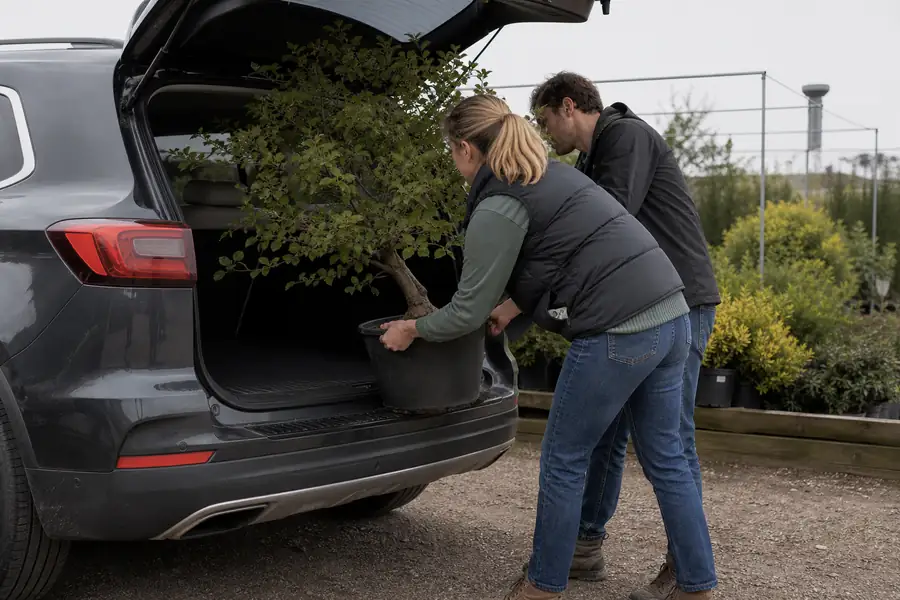
Freight is the cost most people forget to budget for. Ours is $149 flat per order, however many trees the order holds, and checkout shows it before you pay. Delivery is curbside - the driver is not planting it.
We ship to the lower 48. Some species cannot ship to certain states under agricultural rules, and that is noted on the product page. Full terms on shipping.
Planting it yourself
| Item | Typical cost |
|---|---|
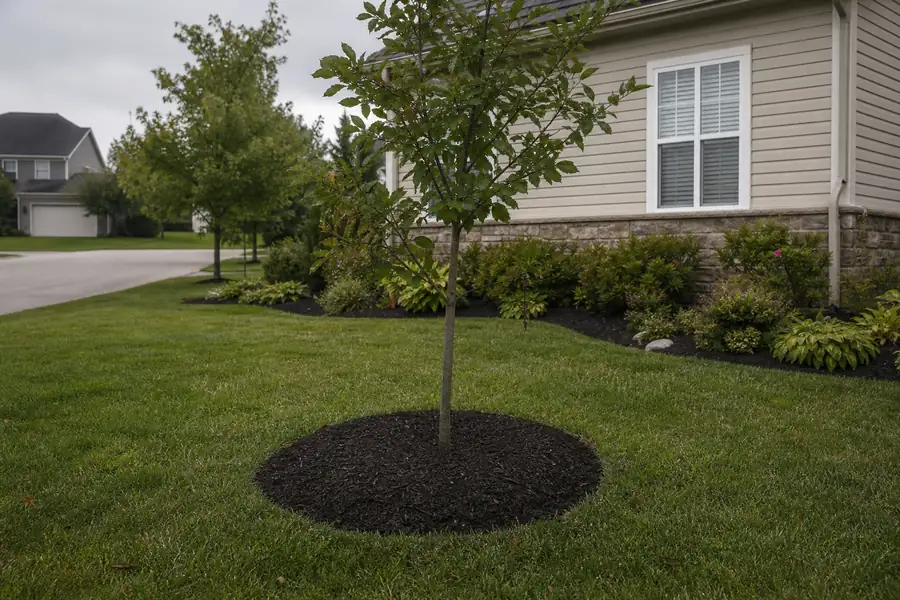
| Mulch (enough for a 6-8 ft ring, 2-3 in deep) | $15 - $30 |
| Stakes and ties, only if needed | $15 - $30 |
| Shovel, if you do not own one | $25 - $50, once |
| Water | Negligible |
| Soil amendments | $0 - you should not be buying any |
That last row is the one that saves money. Backfill with the soil you dug out, and do not fertilize at planting - ISA's guidance is explicit: "Avoid fertilizing at the time of planting." The compost, bagged topsoil, starter fertilizer and root stimulant that people routinely buy are not merely unnecessary, they are counterproductive. See the best soil for planting a tree.
Realistic DIY total: the tree, plus delivery, plus about $20 of mulch.
Paying someone to plant it
Costs vary widely by region, by access, and by tree size, so treat any single number with suspicion - including anything you read online. What is predictable is the structure of the quote:
| Factor | Effect on price |
|---|---|
| Tree size | The dominant factor. A 4-inch caliper tree needs a 42-inch root ball and equipment |
| Access | A tree that must go through a narrow gate or across a lawn costs more than one next to the driveway |
| Soil | Heavy clay, rock or compacted ground is slower to dig |
| Number of trees | Per-tree cost drops substantially on a row |
| Disposal | Spoil from a large hole has to go somewhere |
| Establishment or warranty | Some contractors include a season of watering or their own guarantee |
Rule of thumb for budgeting: on large stock, installation often costs in the same range as the tree. On small stock it is usually not worth paying for.
Get at least two quotes, and ask each one specifically: does the price include delivery, disposal, mulch, staking, and any watering or warranty period?
The hidden cost nobody budgets for: water
A newly planted tree needs 2 to 3 gallons per inch of trunk diameter at every watering (UF/IFAS), two to three times a week for the first few months of a spring or summer planting, then weekly until established.
How long that lasts depends on your hardiness zone:
| Zones | Establishment per inch of caliper | A 2-inch tree |
|---|---|---|
| 10-11 | ~3 months | ~6 months |
| 8-9 | ~4 months | ~8 months |
| 6-8 | ~8 months | ~16 months |
| 2-5 | ~12 months | ~2 years |
Gilman, UF/IFAS. The water itself is cheap on a metered supply; the time is not. A 4-inch caliper tree in a cold zone is a multi-year commitment, and that is the real cost of buying large.
Find your zone to see which row applies to you.
How to spend less
- Buy smaller. The strongest lever by far. A smaller tree costs less, ships cheaper, plants without help, establishes faster, and often catches up with a larger one within a few years - see tree size and establishment.
- Plant it yourself, if the root ball is within your means to move. Up to about 2 inches of caliper is realistic with a second person.
- Buy in multiples if you need several.
- Do not buy amendments. Native backfill, no fertilizer.
- Do not stake unless it is needed. Most trees do not need it - see how to stake a tree.
- Get the zone right first. The cheapest tree is the one you do not have to replace, and planting outside the recommended zone is the one thing most guarantees - including ours - do not cover.
- Consolidate orders to clear free-shipping thresholds or share a freight run.
Worked examples
A privacy screen, 12 Thuja Green Giant at 3-4 ft
Trees at the 10-pack rate, plus mulch for a long bed. Shipping on small stock, so likely free over the $99 threshold. Planting is straightforward DIY - 3-4 ft stock is one-person work. The dominant cost is the trees themselves.
One Eastern Redbud at a front entrance
A single ornamental from $52, free shipping if the order clears $99, about $20 of mulch, planted in an afternoon. Total well under $150.
One Live Oak at 14-16 ft for instant presence
$636 for the tree, plus $149 freight, plus either equipment hire or a planting contractor - and a watering commitment of roughly 16 months to 2 years depending on zone. This is the category where the total is substantially more than the sticker price, and where it is worth deciding deliberately rather than by default.
FAQ
How much does it cost to plant a tree?
Planting it yourself, the cost is the tree plus delivery plus roughly $20 of mulch. Small ornamentals and screening plants run about $40 - $150 all in; a large shade tree delivered by freight runs from around $350 to $800 or more. Professional installation on large stock often costs in the same range as the tree.
How much does a tree cost?
In our catalog, screening evergreens start around $13 - $16, flowering and ornamental trees run roughly $40 - $140, and large shade trees run from about $300 to $500 and up, with the biggest sizes higher.
Is it cheaper to plant a tree yourself?
Yes, substantially, as long as you can handle the root ball. Up to about 2 inches of caliper is realistic with help. Above about 3 inches, equipment or a contractor becomes the practical answer.
Why are large trees so much more expensive?
The grower has carried them for more years, they take more labor and machinery to dig, their root balls are far heavier to ship, and they occupy more nursery ground. Within a single species, doubling the height roughly doubles the price.
Does a more expensive tree grow better?
No. A larger tree loses proportionally more of its root system when dug and takes longer to establish - roughly a year per inch of caliper, more in cold zones. You are paying for immediate size, not for faster growth.
What else do I need to buy?
Mulch, and stakes only if the tree genuinely needs them. You should not buy compost, bagged topsoil, fertilizer or root stimulant - backfill with the soil you dug out.
Does the price include delivery?
Smaller items ship free on orders over $99. Large trees ship by freight for $149 flat per order, shown at checkout, delivered curbside.
Every product page shows the price for each size available, with mature dimensions and USDA range. Find your zone first, then browse the range - everything is covered by our 1-Year Thrive Guarantee.