

Quick answer: Cut a level bench into the slope, set the root ball vertical with the trunk flare 1 to 2 inches above the bench grade, and build a firm berm on the downhill side so water soaks in instead of racing downhill.
Planting on flat ground, you just dig a hole. On a slope, gravity works against you from the first shovelful: soil slides downhill, water runs off before it soaks in, and a tilted root ball sets the trunk growing crooked for life. The fix is a simple two-part system: a flat bench for the root ball and a basin on the downhill edge to catch runoff.
Get those two things right and a slope planting behaves almost exactly like a flat one. Skip them and even a healthy tree can starve for water or start leaning within a season.
How to Plant a Tree on a Slope: Read the Slope First
Most home slopes are fine for DIY planting; anything steeper than about a 3-to-1 grade (three feet of horizontal run for every one foot of drop) calls for terracing or a landscaper instead.
Measure it roughly: if a slope drops one foot in height over less than nine feet of horizontal distance, that grade is steeper than 3-to-1. Beyond that, a bench alone usually won't hold, and heavy rain can undercut a young root ball no matter how carefully you dig.
| Slope grade | Rise per 10 ft run | DIY planting |
|---|---|---|
| Gentle (5-to-1 or less) | Under 2 ft | Yes, standard bench and basin |
| Moderate (4-to-1 to 3-to-1) | 2-3.3 ft | Yes, wider bench and reinforced berm |
| Steep (steeper than 3-to-1) | Over 3.3 ft | Terrace it or hire a landscaper |
Orientation matters too. South- and west-facing slopes catch more direct sun and dry out faster, especially in summer, so plan on extra watering for those exposures. Start by using Arbor Buddy's ZIP-based zone lookup to pick trees rated for your zone before you dig, since a species that handles your winter lows still needs to tolerate a hot, dry slope face.
Cut the Bench Before You Plant
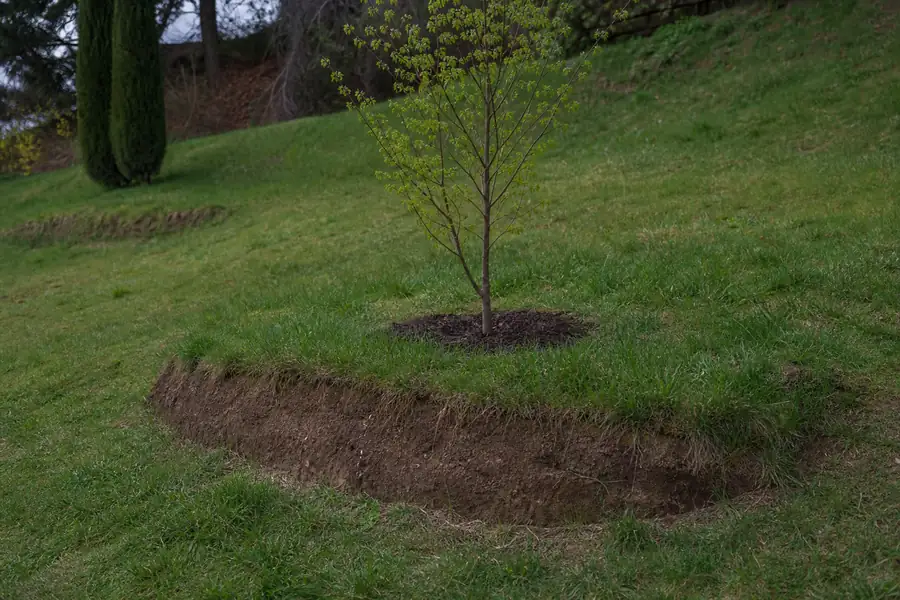
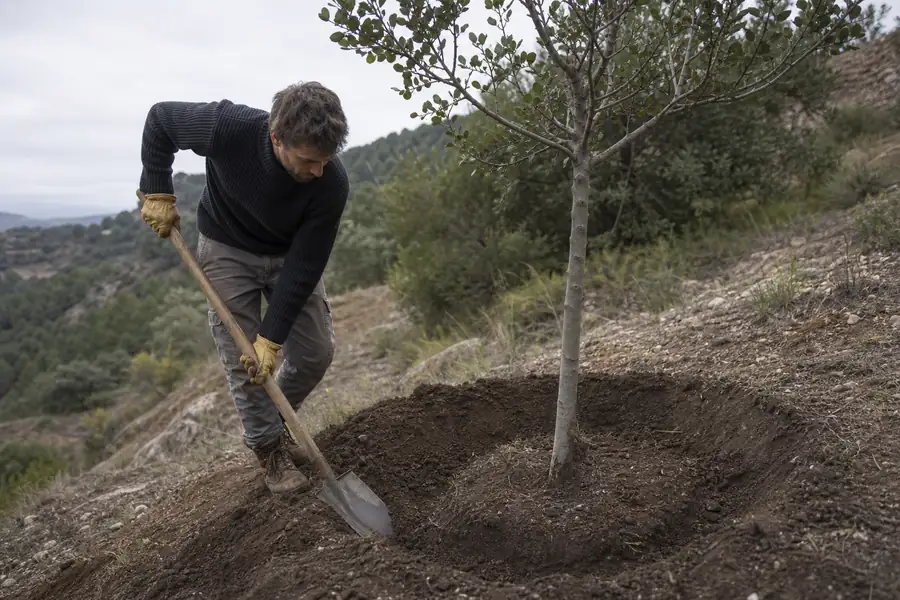
A terrace bench is a flat shelf cut into the uphill side of the slope, sized 2 to 3 times the width of the root ball. That width gives you room to work and keeps the surrounding soil from sliding back into the hole while you plant.
Dig into the uphill face first, then use that soil to build up the downhill edge slightly so the shelf sits level, not tilted with the grade. Check it with a level or a straight board. The goal is a flat pad, not a wedge.
This matters because the trunk needs to grow plumb. A root ball set tilted to match the hillside sends the trunk growing at an angle for years, and a leaning young tree is far more likely to need corrective support later on. The same digging and backfilling fundamentals apply here as on flat ground; if you're also weighing container sizes against how big a hole you'll need, our post on how tree sizes affect planting breaks down what those numbers mean for your dig.
Set the Planting Height on the Bench
Set the trunk flare, where the trunk widens into the roots, 1 to 2 inches above the bench surface. Planting too deep is one of the most common mistakes on a slope, because it hides the flare and traps moisture against the bark.
After the ball is set, feather the uphill cut edge down into the bench so it slopes gently away rather than dropping in a sharp step. That grading sheds surface runoff around the trunk instead of funneling it straight into the root zone every time it rains.
Build the Downhill Berm and Watering Basin
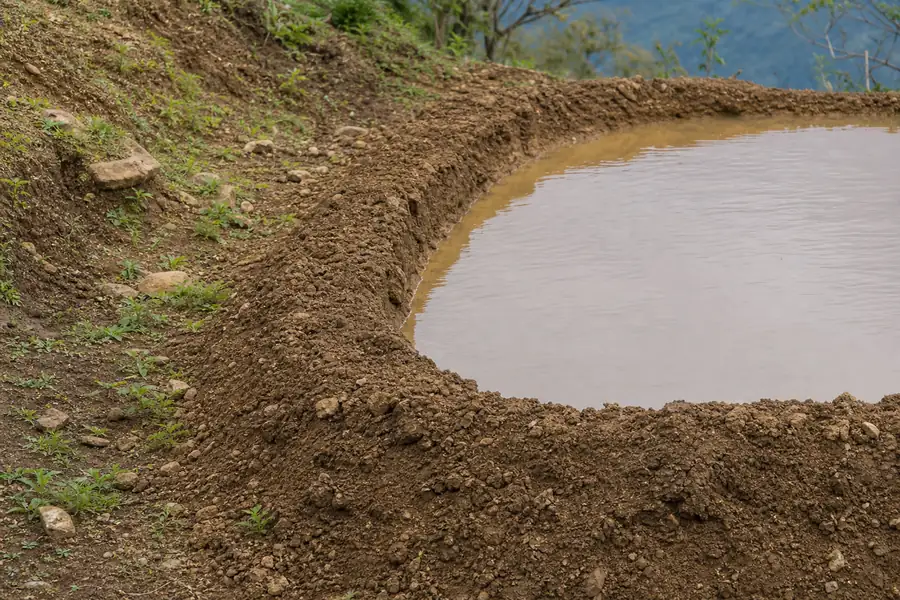
A watering basin is a shallow, level catch area at the edge of the root ball, held in on the downhill side by a firm soil berm 3 to 4 inches tall. That berm is what turns a slope into a spot that holds water instead of shedding it.
Build the berm from firm, compacted soil, not loose mulch, and keep it clear of direct contact with the trunk. Piling soil against the bark traps moisture against it and invites rot. The berm only needs to run along the downhill and side edges of the ball; the uphill side is already higher ground, so it does the blocking on its own.
Size the basin to hold roughly 10 gallons per inch of trunk caliper (the diameter measured a few inches above the flare) each week during the growing season. That's the volume you're trying to keep on-site instead of losing to runoff.
Be honest about maintenance: a downhill berm on a real slope usually gets knocked down or washed thin after the first big storm of the season. Plan to rebuild it by hand a few times during the tree's first year. That's normal, not a sign anything went wrong.
Water Slow on a Slope
Split the weekly watering volume into 2 to 3 slower sessions rather than one hard blast, which is the single biggest change from watering on flat ground. A slope can't absorb a fast pour the way flat soil can; the water just runs off the surface and over the berm before it soaks in.
A soaker hose coiled inside the basin is the easiest fix. It lets water weep out slowly over 20 to 30 minutes instead of pooling and overflowing. Run it at low pressure and check that the basin isn't overtopping the berm.
Before every watering, probe the soil about 2 inches down near the root ball. If it's still damp, hold off a day. Overwatering compacted, sloped clay soils does as much damage as letting them dry out, so err toward less water delivered more slowly rather than more water delivered fast.
Hold the Surface: Mulch, Netting, and Staking
Coarse wood chips, 2 to 3 inches deep, hold their ground on a slope far better than fine, shredded mulch, which floats and washes downhill in the first hard rain. Keep the chips a few inches clear of the trunk itself.
Staple jute netting over any raw, exposed cut edges left from the bench excavation. It's biodegradable, breaks down within a season or two, and holds loose soil in place long enough for grass or groundcover to take root and stabilize the slope on its own.
Staking is more often justified on a slope than on flat ground, since wind and the terrain's own lean both work against a newly planted tree. Use wide, soft straps rather than wire or rope, and remove them within one year: a tree that never learns to stand on its own root system stays weaker long-term. Groundcover and low shrub plantings from Arbor Buddy's shrubs and hedges selection can also help hold a slope's surface once the tree's canopy is established.
FAQs
Should the root ball sit vertical or tilted to match the slope?
Always vertical. Tilting the root ball to follow the hillside forces the trunk to grow at an angle and puts long-term stress on the trunk and root system, even if it looks like it matches the grade at planting time.
How steep is too steep to plant a tree on a slope yourself?
Beyond roughly a 3-to-1 grade, meaning three feet of horizontal distance for every one foot of drop, a simple bench and berm usually can't hold against runoff and erosion. At that grade, terracing the slope or bringing in a landscaper is the safer call.
Where exactly does the watering basin go?
On the downhill side and around the edges of the root ball, formed by a firm soil berm 3 to 4 inches tall. The uphill side of the bench is naturally higher ground, so it already blocks water from running past without any extra berm needed there.
Will mulch just wash off a sloped planting bed?
Fine, shredded mulch will wash downhill in the first heavy rain. Coarse wood chips paired with jute netting over any exposed cut edges hold in place far better and protect the root zone through the first storms.
Do trees planted on a slope need to be staked?
Often, yes, at least briefly. The combination of wind and the slope's own grade puts more sideways stress on a young tree than flat ground does, so a loose staking setup for up to one year is common. Remove the stakes as soon as the trunk can stand upright on its own.