

Quick answer: Newly planted tree care in year one comes down to three things: steady water, the right mulch, and patience. Skip fertilizer and hard pruning, keep the root flare exposed, and expect slow top growth while roots take hold.
Most young trees don't die from bad luck. They die from too much water, too little water, or a planting job that buried the root flare (the point where the trunk widens into the roots) too deep. Get those basics right and a healthy, well-matched tree has a real shot at making it through year one.
Arbor Buddy matches every tree to your USDA hardiness zone before it ships, and every order is covered by our one-year Alive & Thrive guarantee. That takes climate mismatch off the table. What's left is aftercare, and that's what this guide walks through, month by month.
The First 48 Hours of Newly Planted Tree Care
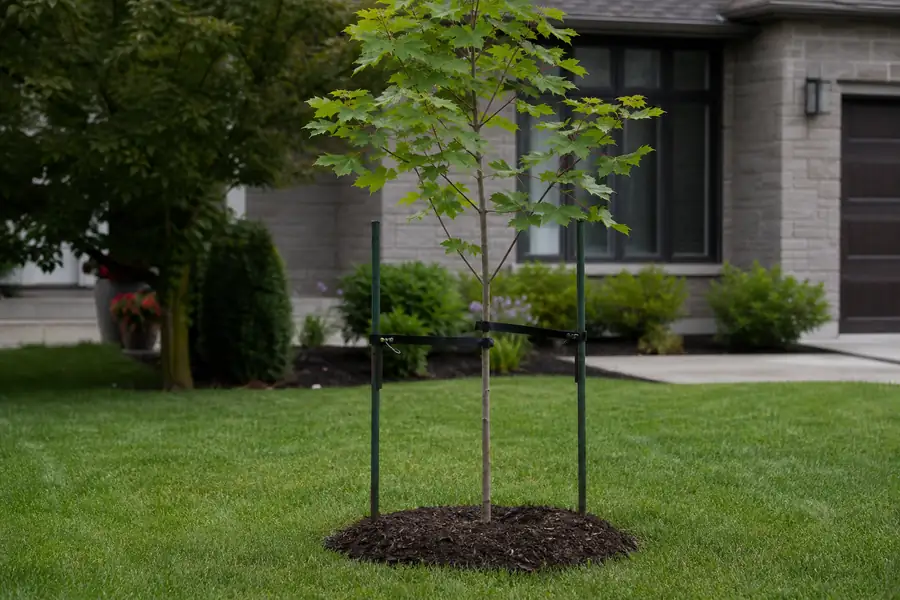
Newly planted tree care starts before the tree even settles in. Confirm the root flare sits at or slightly above grade, never buried under extra soil; a flare planted too deep suffocates roots and is one of the most common killers of young trees.
Water the root ball deeply right after planting to settle the soil and close any air pockets. Then spread 2 to 4 inches of mulch in a wide, flat ring, kept 3 to 6 inches back from the trunk. Pull off nursery tags, stakes, or twine left on the trunk; left in place, they can girdle the bark as the tree grows.
- Root flare visible, not buried
- Root ball soaked thoroughly
- Mulch ring 2 to 4 inches deep, shaped like a doughnut
- Tags, ties, and twine removed
Watering New Trees Month by Month
A newly planted tree needs roughly 10 gallons of water per inch of trunk caliper (the trunk's diameter measured a few inches above the root flare) at each deep soak. A tree with a 2-inch caliper trunk gets about 20 gallons per watering.
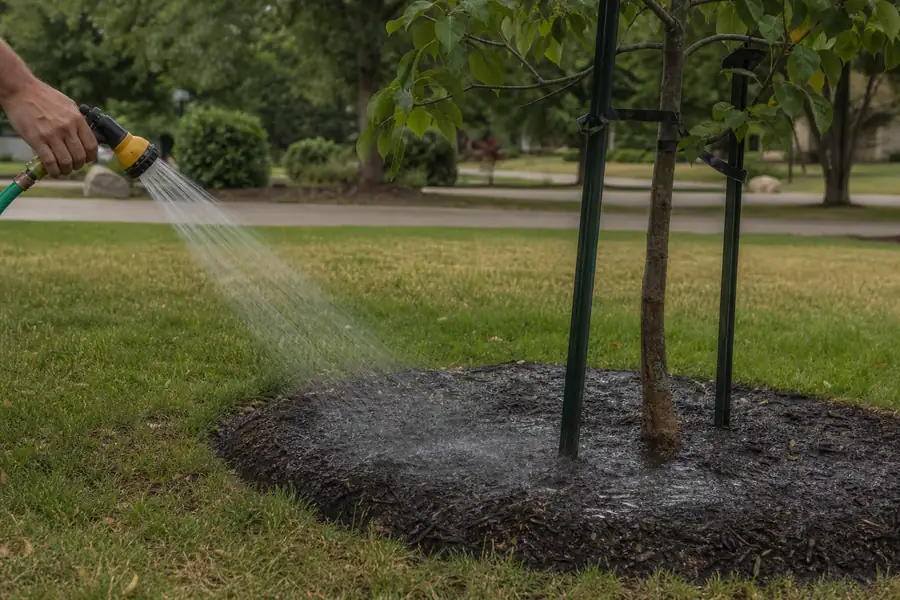
Skip the fixed daily schedule. Water needs run on a curve: heavy and frequent right after planting, tapering off as roots spread into the surrounding soil. Check moisture 4 to 6 inches down before watering; if it's still damp, wait a day.
| Timeframe | Frequency | What to check |
|---|---|---|
| Days 1-14 | Daily | Soil stays moist, not soggy |
| Weeks 3-12 | Every 2-3 days | Check 4-6 inches down before each soak |
| After week 12 | Weekly | Taper further as cooler weather arrives |
University extension research on tree establishment generally backs this same pattern: frequent water early, soaks spaced further apart as new roots take over the job the original root ball was doing alone.
Mulch, Staking, and Trunk Protection
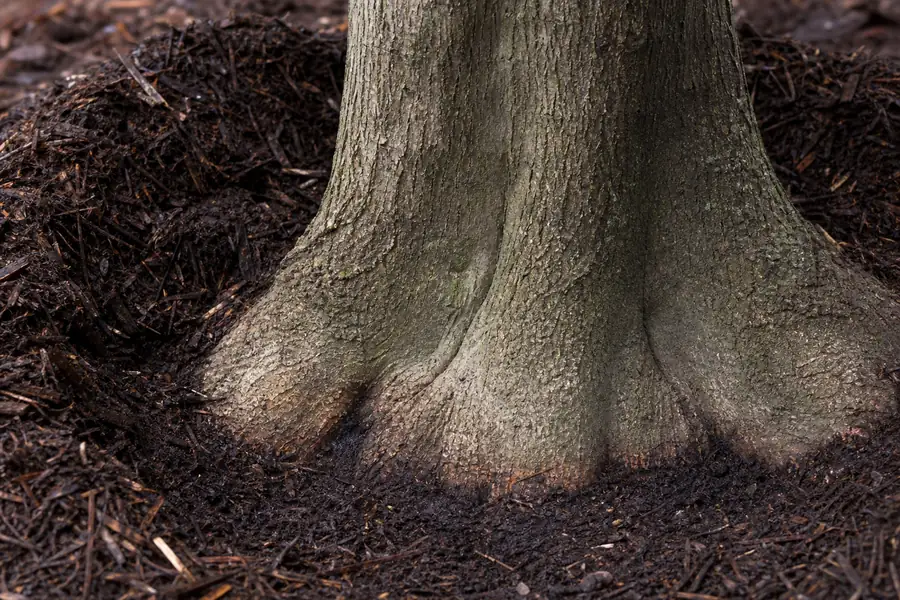
Mulch belongs in a doughnut, not a volcano. Piling mulch against the trunk traps moisture against the bark and invites rot and pests; keep it in a flat ring 3 to 6 inches off the trunk and 2 to 4 inches deep.
Stake a newly planted tree only if the root ball rocks in the wind or the trunk can't hold itself upright. A stable tree doesn't need one, and a tree left staked too long grows a weaker trunk because it never learns to flex on its own. Remove any stakes after one growing season.
Thin, young bark scalds easily in direct winter sun and draws hungry animals looking for an easy meal. A light trunk guard, wrapped loosely from the base up past the first branches, protects against both without trapping moisture against the bark.
What to Skip in the First Year
Doing less beats doing more in year one. Skip nitrogen fertilizer at planting and through the first growing season; a stressed, still-rooting tree can't use the extra growth push, and excess nitrogen can burn tender new roots.
Skip heavy pruning too. Remove only dead, broken, or damaged wood. A newly planted tree needs its full canopy to rebuild the root system it lost at digging, and cutting live branches back only slows that recovery.
Skip rich backfill amendments like compost or potting soil mixed into the planting hole. Ordinary native soil, even if it seems plain, lets roots grow out into real ground instead of staying trapped in a softer pocket that holds too much water.
Normal Signs Versus Trouble Signs
Some leaf drop and slow top growth are normal for a newly planted tree working through transplant shock, the stress response a tree shows after losing part of its root system at digging. Most trees put energy into roots before canopy in year one, so don't expect fast height gains.
Wilting paired with soggy soil signals overwatering, not thirst, and more water only makes it worse. Scorched, crispy leaf edges paired with dry soil at the root zone signal underwatering. Check the soil before reaching for the hose either way.
| Symptom | Soil condition | Likely cause |
|---|---|---|
| Wilting, drooping leaves | Wet, soggy | Overwatering |
| Scorched, brown leaf edges | Dry, crumbly | Underwatering |
| Some yellow drop, slow growth | Normal moisture | Typical transplant adjustment |
Newly Planted Tree Care Through the Seasons
Summer calls for deep, less-frequent watering rather than light daily sprinkles, since heat and root growth both pull moisture down and out fast. A soak that reaches 8 to 12 inches down does more good than a quick surface spray every day.
Give the tree one heavy soak before the ground freezes in fall; roots absorb water right up until the soil locks up, and a well-hydrated tree handles winter cold better than a dry one. In winter, wrap the trunk of thin-barked young trees against sunscald, and shield evergreens from drying wind that can pull moisture out of needles faster than frozen roots can replace it.
When Is a Newly Planted Tree Established?
A newly planted tree is generally established after about one year per inch of trunk caliper, so a 2-inch caliper tree needs roughly two years before its root system matches what it had before digging. Larger trees from Arbor Buddy's tree size guide follow the same math, just scaled up.
Taper watering gradually as that timeline plays out, once roots visibly spread past the edge of the original root ball into the surrounding soil. An established tree needs about as much water as the rest of the yard and no special routine.
None of this compensates for the wrong tree in the wrong climate to begin with. Arbor Buddy's Plant Finder matches species to your yard and USDA zone before you buy, so the tree going in the ground is already suited to your winters and summers, not just hoping to survive them.
FAQs
How often should I water a new tree?
Water daily for the first two weeks, then every two to three days through about week twelve, then weekly after that. Always check the soil 4 to 6 inches down first and skip the soak if it's still moist, since overwatering kills more new trees than underwatering does.
Should I fertilize a newly planted tree the first year?
No, skip fertilizer, especially nitrogen, during the first growing season. A newly planted tree is focused on rebuilding roots, not producing new top growth, and extra nitrogen can burn tender young roots before they've had a chance to spread.
Why is my new tree losing leaves?
Some leaf drop and slower growth are normal signs of transplant shock as the tree adjusts on its smaller root system. If leaves are wilting and the soil is soggy, cut back on water; if leaves are scorched and the soil is dry, water more deeply.
How long until a newly planted tree is established?
Plan on roughly one year of establishment for every inch of trunk caliper, so a 2-inch caliper tree needs about two years. Once roots spread past the edge of the original root ball, watering needs taper toward what the rest of the yard gets.
Do I have to stake a new tree?
Only if the root ball rocks in the wind or the trunk can't stand upright on its own. A stable tree grows a stronger trunk without a stake, and any stake that is used should come off after one growing season.
Should I wrap the trunk in winter?
Wrap thin, young bark loosely with a trunk guard to protect against winter sunscald and gnawing animals. Evergreens benefit from wind protection too, since drying winter wind can pull moisture out of needles faster than frozen roots can replace it.